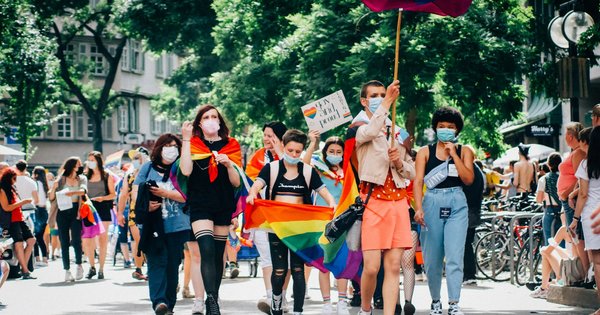
Germany has never had so many Prides. It has also never had so many of them attacked.
That’s the headline from the Amadeu Antonio Foundation’s end-of-season count, published on October 26. The Berlin-based foundation, which tracks far-right activity in Germany, calls it “two new records.”
The numbers
- At least 299 Christopher Street Day (CSD) events took place in Germany in 2026, the most ever.
- At least 156 of them were attacked or disrupted in some way. That’s more than half.
- At least 19 physical attacks on marchers, up from 4 in 2025.
- 27 cases of property damage and 58 documented insults, GGG.at reports from the monitoring.
- Organised far-right counter-protests actually fell, from at least 43 to 27.
All of these are minimums. The foundation builds its count from media reports, its own observation and questions to organisers, so the real figures may be higher. And “156 affected” doesn’t mean 156 Prides saw violence: a disruption can be anything from insults shouted at the march to eggs thrown from a window.
Fewer organised far-right marches, more random attacks
The shift is the interesting part. Last year, the story of Germany’s Pride season was organised far-right counter-marches, many of them drawing teenagers, especially in the east. We wrote about it before this season started.
This year there were fewer of those. But according to Belltower.News, the foundation’s own news site, the far right has become less organised this year, but not less dangerous. Many of the physical attacks came from individuals or from spontaneous groups that never registered a protest, which makes them much harder for police and organisers to plan around.
The report names a few:
- Kassel: a man shoved marchers, and one person hit their head on the ground.
- Chemnitz: someone in a neighbouring building threw eggs at the march, injuring a participant who uses a wheelchair.
- Landshut: a lone man hit a participant.
And then there was Berlin. The report also counts the Islamist attack at the end of Berlin’s CSD in July, when a van was driven into a crowd in the Tiergarten and one woman was killed. The foundation says violence against queer people from Islamist ideology has to be taken seriously as a threat, alongside the far right.
East and West
The east is still where Pride is most exposed: 62% of CSDs in eastern German states were disrupted. But the west is catching up fast, from 38% in 2025 to more than 47% this year.
“Increasingly, these attacks are accepted as normal and get hardly any public attention,” Belltower.News writes. “The threshold for anti-queer violence seems to be falling further and further.”
The quieter pressure: money and paperwork
Not every threat came from the street. The foundation points to two other trends:
- Assembly status. Authorities in Dresden and Görlitz tried to take away their CSDs’ status as political assemblies. Without it, organisers would have to pay costs such as security staff themselves. The foundation warns that bill could end small rural Prides.
- Funding. CSDs in Rathenow and Lünen were refused money from the federal “Demokratie leben!” (Live Democracy!) programme, with political neutrality given as the reason. It fits a pattern we’ve followed all year, from the Bundestag refusing to fly the rainbow flag to the federal government pulling funding from its main LGBTQ+ youth network.
The foundation warns that pressure on CSDs that rely on local council funding will grow, especially if the far right ends up in government in Saxony-Anhalt.
So why are there more Prides than ever?
Because people keep showing up. More CSDs were held this year than ever, many of them in places where it takes real nerve. We covered one in Zwickau, and in Hamburg, where 300,000 people marched one week after the Berlin attack.
The foundation helped: with support from the football club FC St. Pauli, it paid for security at 28 small-town CSDs, 19 of them in the east.
What the foundation wants
- Politicians who speak up clearly for queer visibility
- Stable, reliable funding for CSDs
- Real protection, with police better prepared for attacks like Berlin’s and quicker to react to unregistered groups
- Anti-queer violence named for what it is, whoever commits it
The takeaway
Two things are true at once. Queer Germans, in big cities and small towns, held more Prides in 2026 than ever before. And the people who want them gone have shifted from organised marches to something harder to see coming.
The fix isn’t fewer Prides. It’s making sure the small ones aren’t left to pay for their own safety.