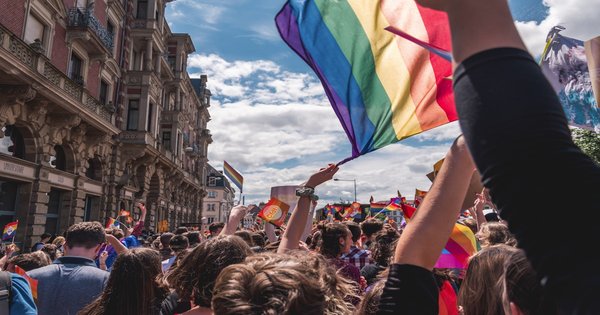
One week after a van-and-blade attack tore through Berlin’s Christopher Street Day celebrations, Hamburg’s Pride march went ahead as planned on Saturday, August 1 — and hundreds of thousands showed up anyway.
Police and organizers put attendance at roughly 300,000, one of the largest Hamburg Pride turnouts in years, under a police presence that officials said was roughly double what the march saw in 2025. This year’s motto, chosen well before the Berlin attack, turned out to be grimly apt: “Queer in solidarity. Take a stand — for a future without fear.”
The mood was deliberately dual. Rainbow flags and floats moved through the city under clear skies, but many marchers wore dark clothing as a tribute to the one person killed and roughly 30 people injured in Berlin on July 25. A truck representing Berlin’s own Pride organization joined the Hamburg parade as a late addition, a visible link between the two cities’ queer communities in the space of a single week.
“When something like that happens, we all have to show that we’re not afraid,” attendee Petra Schwab told reporters at the march. Hamburg’s deputy mayor struck a similar note in local broadcast remarks, urging residents to “take to the streets, stand up for diversity, for freedom, for an open society — now more than ever.” Members of the Bundestag and Hamburg’s Second Mayor marched as well, a level of official political presence organizers read as a deliberate show of state support.
The Berlin attack that shadowed Saturday’s march happened on the night of July 25, near the closing celebrations of that city’s Christopher Street Day. According to German prosecutors, 21-year-old Abdul Rahman Ballout — a German citizen with Lebanese roots who had a prior terrorism-linked conviction and was on probation in a court-ordered deradicalization program — drove a van into the crowd before attacking bystanders with a bladed weapon. A 65-year-old Polish woman was killed; at least 29 others were injured. Police shot and killed Ballout the following day after he charged officers with a blade. Investigators say they found video evidence suggesting he had pledged allegiance to the Islamic State and had previously tried to travel to fight for the group in Lebanon. Germany’s Federal Prosecutor’s Office, which handles terrorism cases, took over the investigation.
That attack landed during a European Pride season already marked by heightened security anxiety — Austrian intelligence services disrupted a separate alleged Islamist plot targeting Vienna’s Pride parade earlier this year, and Amsterdam tightened security for WorldPride in its aftermath. Hamburg’s decision to proceed at full scale, rather than scale back, is itself a statement: German officials and Pride organizers across the country have framed cancellation as handing attackers exactly the outcome they want.
Hamburg’s CSD has run since the 1990s and is now among Germany’s largest Pride events outside Berlin and Cologne. For a community that just watched its counterparts in the capital bury a stranger killed for being near a Pride celebration, Saturday’s turnout functioned as both celebration and rebuttal — proof, organizers said, that fear hadn’t shrunk the crowd, only sharpened its resolve.
German authorities have not announced any new, specific threats tied to Hamburg’s march. Security officials in cities with upcoming Pride events elsewhere in the country are reviewing protective measures in light of the Berlin attack, according to local reporting.