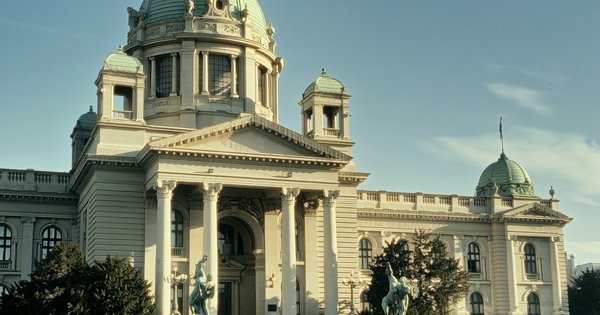
Serbia woke up on Monday to a different country. In Sunday’s snap election, the Student List, born out of two years of student-led protests, won an outright majority in parliament. Aleksandar Vučić conceded defeat, and his Serbian Progressive Party (SNS) is out after 14 years in power.
For LGBTQ+ Serbians, that’s a genuinely new moment. It’s also an open question. Here’s what we actually know.
The result, in numbers
With 8,135 of 8,392 polling stations counted, the state election commission had the Student List on 52.65% and the SNS-led “United Serbia” list on 39.2%, Balkan Insight reported. Turnout was 68.8%.
That projects to 140 of 250 seats for the Student List and 103 for United Serbia, with the rest going to Hungarian, Albanian and Bosniak minority lists. In plain terms: the students can form a government on their own, without a coalition.
They haven’t named a prime minister yet. The list’s candidates are mostly experts and professors chosen by student assemblies; the first name on it is Ilija Srdanović, a professor at the Medical Faculty in Novi Sad.
How Serbia got here
The movement started after the November 2024 collapse of a railway station canopy in Novi Sad, which killed 16 people. Students turned grief into nearly two years of blockades and marches against corruption.
On September 9, Vučić called this snap election. On September 27 he resigned as president, AP reported, so he could lead his party’s list and become prime minister if it won. It didn’t. In the meantime, parliament speaker Ana Brnabić, Serbia’s first openly lesbian prime minister, became acting president. A presidential election still has to follow.
Queer Serbia was in this fight
LGBTQ+ people didn’t watch the protests from the sidelines. At Belgrade Pride on September 5, one banner read “Queer students are winning too”, a play on the movement’s own slogan, Studenti pobeđuju (“Students are winning”), Balkan Insight reported.
Pride Week even ran a session called “We Vote, Too! The LGBT+ Community and the Upcoming Elections”, according to its programme. This year’s Pride godmother, journalist Danica Vučenić, said the march was happening “at a time when violence is being glorified,” pointing to rising homophobic attacks and police violence against protesters.
What the program says, and what it doesn’t
We read the Student List’s 11-point program. It’s about institutions: independent courts, a special anti-corruption police unit, open public contracts, free textbooks, a doctor in every village.
A few lines matter for queer Serbians:
- It promises a state where “zakon važi jednako za sve”: the law applies equally to everyone.
- It calls for accountability for officials who “kršili ljudska prava” (violated human rights).
- It wants to examine the responsibility of TV newsrooms for “dugogodišnjoj diskriminaciji i širenju govora mržnje”: long-standing discrimination and the spread of hate speech.
What it doesn’t do is name LGBTQ+ people, same-sex couples or trans people anywhere. It also promises affordable housing for “mladi parovi”, young couples, without saying whether couples the state doesn’t recognise would count.
That’s not a betrayal. It’s a blank. And blanks get filled by whoever shows up.
The laws Serbia still doesn’t have
The to-do list hasn’t changed in years. Serbia has no Law on Same-Sex Partnerships and no Law on Gender Identity; Belgrade Pride has demanded both, plus a state apology to people prosecuted before same-sex relations were decriminalised in 1994. Trans people can change their legal gender, but only through a medical route, as we covered in our state-of-rights explainer.
The old government’s record is clear. In 2023 Vučić said he’d asked Brnabić, then prime minister, not to advance same-sex marriage legislation: “I am the one who didn’t allow it,” Balkan Insight reported. This September, his human rights minister said a union law could arrive in spring. That promise now belongs to a government that just lost.
Europe is watching, and so are the neighbours
EU leaders moved fast. Ursula von der Leyen said the EU “stands ready to support reforms on the rule of law, media freedom, the fight against corruption,” and Enlargement Commissioner Marta Kos wrote: “The door to the EU is open,” Balkan Insight reported.
One congratulation stood out. Hungary’s new prime minister, Péter Magyar, said he was “delighted to hear how much strength our victory in April had given them.” Since that April win, Hungary’s parliament has voted to strip the anti-LGBTQ+ parts of Orbán’s “child protection” law. A change of government doesn’t automatically mean change for queer people, but in Budapest it has.
Serbia ranks 29th in Europe on ILGA-Europe’s 2026 Rainbow Map, with 34%. Montenegro, next door, has had same-sex partnerships since 2021.
The honest read
Nobody knows yet what a Student List government will do for LGBTQ+ people, and anyone who tells you otherwise is guessing. What’s real: a movement that queer students helped build, a program that promises equal law for everyone, and a parliament full of first-time MPs who haven’t been asked these questions on the record.
So ask them:
- Will the new government put a Law on Same-Sex Unions on its first-year agenda?
- Does “equal law for everyone” include a gender identity law?
- Will “young couples” housing help include couples Serbia doesn’t yet recognise?
“Queer students are winning too” was a banner in September. The next few months decide whether it becomes policy.
Sources: Balkan Insight: results, concession, European reactions, Belgrade Pride 2026; Student List program; AP via ClickOnDetroit; Belgrade Pride Week programme; ILGA-Europe Rainbow Map 2026. Photo: Skaars / Unsplash.