For the first time, a Balkan country is being led, at least on paper, by an openly LGBTQ+ head of state.
On September 28, 2026, Serbia’s parliament speaker Ana Brnabić took over the duties of President of the Republic, the day after Aleksandar Vučić resigned, the Serbian government announced. It was also her 51st birthday, IBTimes UK noted.
It’s a genuine first. It is also temporary, mostly ceremonial, and tied to an election strategy. Here’s what it actually means.
Why Vučić stepped down
Vučić resigned on September 27, around eight months before his term would have ended, according to an analysis by Poland’s Centre for Eastern Studies (OSW). He had announced back in June that he would step down.
The reason: Serbia holds snap parliamentary elections on October 25, and Vučić wants to run for prime minister. He said he wanted to “compete, as an ordinary person, as a man of the people,” European Western Balkans reported.
OSW’s reading is more skeptical. It notes that Vučić had already attended 173 events around the country between May and August, and that splitting the presidential and parliamentary votes may help his side in the parliamentary race, where the student-led opposition that grew out of protests after the November 2024 Novi Sad disaster poses its strongest challenge since 2012.
What Brnabić can and can’t do
Under Serbian law, the speaker of the National Assembly performs the president’s duties “for a period not exceeding three months,” the government said. She must also call a presidential election so that voting happens no later than three months after the president’s term ended.
The presidency is largely ceremonial. Still, IBTimes UK lists real powers that come with it: representing Serbia at home and abroad, receiving foreign diplomats, calling parliamentary elections, proposing a candidate for prime minister and commanding the armed forces.
She is now the first person in Serbian history to have held all three top offices: prime minister, speaker and (acting) head of state. Receiving the presidential seal was “a bit ironic,” she said, since she had spent her “whole professional life fighting against the seal.”
Who she is
- 2017: Brnabić became Serbia’s first woman and first openly gay prime minister, taking office in June 2017.
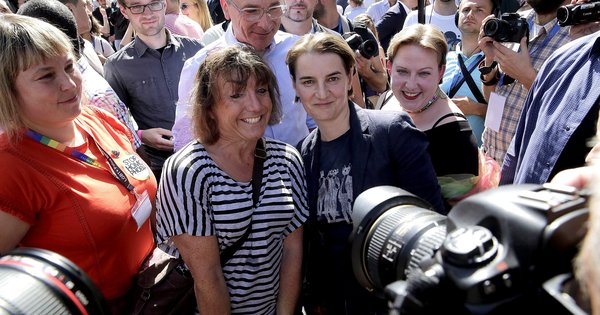
- September 2017: She joined the Belgrade Pride march, the first Serbian prime minister to do so. “The government is here for all citizens and will secure the respect of rights for all citizens,” she told reporters, VOA reported.
- February 2019: Her partner, Milica Đurđić, gave birth to their son. Her office called her “the first in the world in a same-sex couple” to have a partner give birth while serving as prime minister, RFE/RL reported.
- 2024: After nearly seven years as PM, she became speaker of parliament.
The complicated part
Here’s the tension many queer Serbians feel: having a lesbian at the top has not translated into rights at the bottom.
When she was first appointed, Brnabić asked, “Why does it matter?” and said she didn’t want to be known just for being gay. Serbian LGBTQ+ activists have since criticised her for not advocating for equality, even as a parent in a same-sex couple herself, PinkNews reports.
The law tells the story plainly. Serbia’s constitution defines marriage as a union of a man and a woman. Same-sex couples can’t form any legal partnership or adopt together, and when Brnabić’s son was born, only his birth mother was recognised as his legal parent, RFE/RL reported.
And the man she served for years has been open about blocking change. In 2023 Vučić said he had asked Brnabić, then PM, not to advance same-sex marriage legislation: “I am the one who didn’t allow it,” Balkan Insight reported.
As we reported yesterday, Serbia’s human rights minister now says a same-sex union law could move in spring 2027, after a new parliament is in place.
Why it still matters
Representation isn’t policy. But it isn’t nothing, either.
Serbia is a country where the first Pride march in 2001 was attacked. This September, the 25th-anniversary march passed off peacefully under the same slogan as the first, “There Is Room for All of Us,” Balkan Insight reported. Now a lesbian mother is signing papers as head of state, even if only for a few weeks.
For queer kids in Niš or Novi Pazar, that picture exists now. What it’s worth will be measured by what the next parliament does with the union law.
What happens next
- October 25: parliamentary elections.
- By late December: a presidential election must be held, within three months of Vučić’s resignation.
- Brnabić’s acting presidency ends when a new president takes office. OSW names her as one possible presidential candidate for the ruling party, alongside Constitutional Court president Vladan Petrov. No candidate had been named when OSW published its analysis.