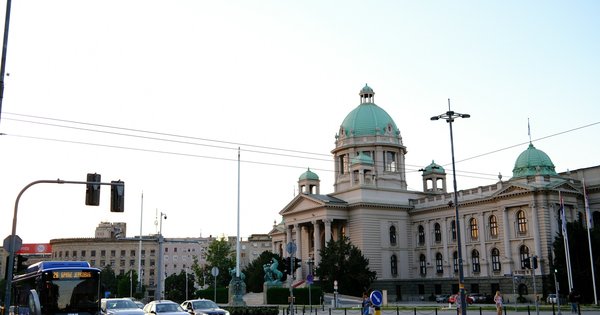
Serbia’s parliament has a new shape, and for the first time in 14 years it isn’t Aleksandar Vučić’s.
The National Assembly held its constitutive session on November 17, the first sitting since the Student List won an outright majority in the October 25 election. Two days later, a Student List MP was elected speaker. And on November 19, the LGBT+ organisation Da se zna! (“Let It Be Known!”) put its first big ask to the new majority: pass a law on same-sex unions, and do it within six months.
Here’s what happened this week, and what it could mean for queer couples in Serbia.
The new parliament, in numbers
According to Balkan Insight:
- Student List: 140 seats of 250, an absolute majority.
- Serbian Progressive Party (SNS): 103 seats, down from 129.
- Minority lists: 7 seats between them.
- Turnout in October was 68.9%, a record, with the Student List on about 53% of the vote.
The Student List grew out of the student-led protests that followed the November 2024 canopy collapse at Novi Sad’s railway station, which killed 16 people.
The clock is now running. Parliament has 90 days from its constitution to elect a new government. If it doesn’t, the president dissolves the Assembly and Serbia votes again.
A new speaker, who is also acting president
On November 19, MPs elected Aleksandar Čupić, a Student List MP and academic, as speaker by 140 votes to 97, Balkan Insight reported. In his first address, he said he wanted to “restore dignity to the country’s highest legislative body.”
That job comes with a second one. Vučić resigned as president on September 27 to run for prime minister, and the speaker fills in until a new president is elected. That role passed from Ana Brnabić, Serbia’s first openly lesbian prime minister, who served as acting president while she was speaker, to Čupić. He told FoNet the presidential election would be announced by November 27, “in line with the legal deadline,” IntelliNews reported.
Why it matters for this story: under Serbia’s system, laws passed by parliament go to the president to be signed. Vučić said in the past that he would not sign a same-sex unions law. He’s no longer in that office.
What Da se zna! is asking for
In a press release carried by the Beta news agency, Da se zna! asked the new majority to:
- Put the Law on Same-Sex Unions among its priorities, and ensure it’s adopted in the first six months of the new government’s mandate.
- Write it with LGBT+ organisations and experts at the table.
- Start regular dialogue with LGBT+ civil society, plus concrete measures against discrimination and violence.
The group’s case is practical. It says that “one of the most important unresolved issues remains the legal recognition of same-sex unions,” and that same-sex couples in Serbia still lack proper legal protection in inheritance, joint property, healthcare and social security. If your partner is in hospital, or dies, the law treats you as a stranger.
It was blunt about the outgoing government, too. Da se zna! described its attitude toward LGBT+ activists as hostile, marked by stigma, public attacks and no real dialogue, and said hate crimes have grown “from year to year.” It wants the new government to end that practice and build a relationship “based on cooperation.” (Quotes are our translation from Serbian.)
Haven’t we heard this before?
Yes, and that’s exactly the point activists are making.
A draft law was prepared in 2021 with input from civil society, Da se zna! notes, and never adopted. Vučić announced he wouldn’t sign it. As recently as September, the outgoing human rights minister said a union law could come “in spring”, shortly before snap elections were called.
Belgrade Pride’s 25th-anniversary march on September 5 again put a same-sex unions law and a gender identity law at the top of its demands, alongside an apology to people prosecuted for their sexual orientation or gender identity, European Western Balkans reported.
What the Student List has (and hasn’t) said
Here’s the honest caveat. As we reported after the election, the Student List’s 11-point program promises equal law for everyone, but it doesn’t mention LGBTQ+ people. We haven’t seen the new majority respond to Da se zna!‘s call yet.
What we do know: the new majority says it wants to move closer to the EU. Serbia is an EU candidate that has been accused of backsliding on democratic values, and Student List MP Aleksandar Baucal told an EU forum in Brussels: “For us, the European path is one of reforms,” according to Balkan Insight.
Whether “reforms” includes legal recognition for same-sex couples is the question queer Serbians will be asking over the next 90 days, as the coalition writes its program.
What to watch next
- By November 27: the presidential election is due to be called.
- Within 90 days of November 17: a new government, with a prime minister and a program. Watch whether same-sex unions or gender identity make it into either.
- The next six months: Da se zna!‘s own deadline for the law.
Change in Serbia has rarely been fast. But for the first time in a long while, the people who’d sign, propose and vote on this law are all new. That’s worth paying attention to.