National parliaments get the headlines. But whether a Pride march gets a permit, whether a queer youth centre gets a room, and whether anyone writes down that someone spat at a couple on the tram: that’s usually decided at city hall.
Now Europe’s own body for local and regional government has spelled out what city hall should be doing.
What was adopted
On Wednesday, October 28, the Council of Europe’s Congress of Local and Regional Authorities adopted a report called “Free to speak, free to meet: guaranteeing the rights of LGBTI persons in local communities” at its 51st session in Strasbourg, queer.de reported. The session ran from October 27 to 29. The report comes with Resolution 537 (2026) and Recommendation 560 (2026), according to a session summary on myota.gr.
Its co-rapporteurs were Helen Belcher from the United Kingdom and Gudrun Mosler-Törnström from Austria.
The report finds significant gaps in protection at local and regional level. Its starting point is a number from the EU Fundamental Rights Agency: the share of LGBTI people in Europe who reported hate-motivated harassment rose from 37% in 2019 to 55% in 2024.
The to-do list
The Congress is asking cities and regions to:
- Let Pride happen. Facilitate Pride marches and other peaceful LGBTI events without disproportionate red tape, and provide police protection where it’s needed.
- Back the groups doing the work. Give LGBTI organisations practical and, where feasible, financial support, and strengthen safe community and cultural spaces.
- Name a person. Appoint a permanent contact point for LGBTI equality in the administration.
- Train people. That means teachers, public officials, and police and security staff.
- Count it. Systematically record hate speech, threats and attacks, so protection is based on evidence rather than guesswork.
It also asks national governments to give municipalities the legal powers and money to actually do all this.
“Progress is not universal,” Mosler-Törnström said, according to queer.de. “We are also seeing setbacks and the refusal of some to uphold the rights.” Her bottom line: “Human rights are for everyone.”
The myota.gr summary puts the principle behind the report this way: human rights apply to everyone, and enforcing them can’t depend on whether a local majority happens to accept a particular group.
Where this bites
Plenty of 2026’s Pride fights were local ones.
In Romania, Oradea’s city hall refused to authorise Pride for a fourth year running, rejecting all 115 route variants organisers submitted. The same Congress had publicly urged the city to let the march go ahead. In Serbia, Belgrade marches every year while authorities in Kruševac banned a Pride event outright. In Germany, queer.de notes that authorities in Dresden and Görlitz initially wouldn’t fully recognise their Prides as political assemblies, which would have pushed big costs onto organisers. Görlitz’s was later recognised, and Dresden’s went ahead as planned.
Those are exactly the kinds of decisions this report is aimed at: not a ban written into national law, but a permit refused, a route rejected, costs shifted onto organisers.
What it can and can’t do
Be clear-eyed about it: Congress resolutions aren’t binding law. Nobody gets fined for ignoring one.
What the report does is give organisers and friendly councillors a document with the Council of Europe’s name on it. It sets a standard, and it backs up what the European Court of Human Rights has long said: the state’s job is to protect peaceful assemblies, not to ban them because protecting them is inconvenient. It also lands alongside the Council of Europe’s first-ever LGBTI equality strategy, adopted in September. Together they amount to a fairly clear message from Strasbourg: the rights exist everywhere, including in your town.
If you’re organising Pride next year, print the report and bring it to your first permit meeting.
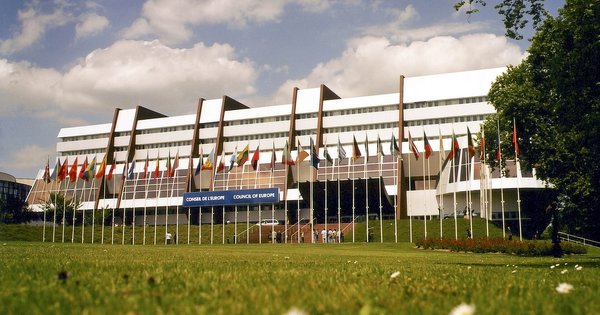
Sources: queer.de, “Europarat: Kommunen müssen queere Menschen besser schützen” (Oct 29, 2026); myota.gr, 51st session summary (Oct 31, 2026); Council of Europe Congress press release (Oct 28, 2026). Quotes translated from German. Photo: Council of Europe, Palais de l’Europe, Strasbourg, CC BY 3.0, via Wikimedia Commons.