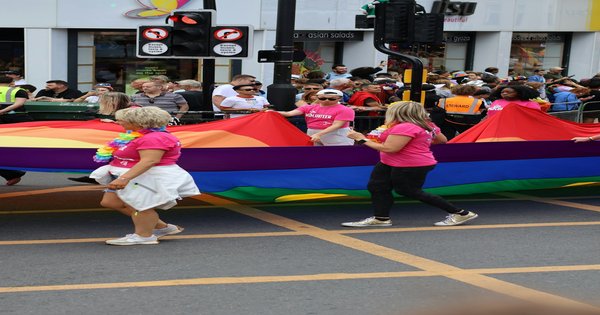
For the fourth year running, city hall in Oradea, Romania, refused to authorize a Pride march. For the fourth year running, organizers held it anyway.
Oradea Pride went ahead Saturday, July 25, despite Mayor Florin Birta’s administration rejecting every one of the 115 route variants organizers submitted. City officials cited overlap with other approved events and ongoing infrastructure work, while also invoking vague language about “social norms of conduct and public morality” — a justification rights groups say has no basis in Romanian law, which guarantees freedom of peaceful assembly.
Marchers gathered outside city hall around 4 or 5 p.m. and walked a route through Independence Street, December 1st Square, Traian Moșoiu Street, and into Union Square. Romania’s national Ombudsman, Renate Weber, along with observers from foreign diplomatic missions, monitored the march. No arrests were reported, but organizer Iulian Dîrțu was verbally notified of a 5,000 lei fine (roughly $1,100) for organizing an unauthorized public gathering, and other participants received smaller fines, reportedly up to 1,000 lei each, for taking part in it. Witnesses said marchers responded to the citations by singing rather than backing down.
The ban drew condemnation well before marchers ever hit the street. The Council of Europe’s Congress of Local and Regional Authorities, the European Greens, Romania’s SENS party, and more than 120 civil society organizations across 30 countries — coordinated through groups including ILGA-Europe, EPOA, IGLYO, and Forbidden Colours — had publicly urged Oradea to allow the march to proceed on its proposed route.
Nicu Ștefănuță, a Romanian member of the European Parliament and one of its sitting vice presidents, was among the sharpest critics. “These young people are not ‘some LGBT people,’” he said, adding that “this shame will not wash away easily” and that “Romania has reached the point of banning, fining, threatening people who protest peacefully.”
Ombudsman Weber echoed that assessment, saying freedom of peaceful assembly is constitutionally guaranteed and that “the mayor is misinterpreting legislation.” Romanian Prime Minister Ilie Bolojan offered a more hands-off response, saying local authorities have legal competence to regulate public gatherings while claiming he lacked details on the specifics of Oradea’s decision.
The standoff fits a broader pattern across parts of Eastern Europe, where Pride organizers increasingly treat official bans as procedural obstacles to route around rather than reasons to cancel. Budapest saw something similar earlier this year, when its Pride march went forward despite legal challenges from the government, drawing record crowds. Oradea’s Pride is far smaller than Budapest’s, but the dynamic is the same: a local or national government asserts a technical or moral justification for blocking a march, and organizers, backed by European institutions and civil society, hold it anyway.
Romania decriminalized homosexuality in 2001 — one of the last European Union countries to do so — and has moved slowly on LGBTQ+ rights since. The country still does not recognize same-sex civil partnerships or marriage nationally, though a 2026 Romanian court ruling required recognition of a same-sex marriage performed abroad in at least one case. Romania’s ranking on ILGA-Europe’s annual Rainbow Map has consistently trailed most of the EU.
For a city of roughly 190,000 people near Romania’s border with Hungary, Oradea’s repeated Pride bans have become an annual test of how far local officials can push back against a march their own country’s laws are supposed to protect. This year, as in the previous three, the marchers didn’t wait for permission.
The pattern also underscores a gap that keeps surfacing across the EU’s newer and prospective member states: national-level commitments to human rights standards, made in Brussels or Strasbourg, don’t always translate into what a local mayor is willing to permit on a Saturday afternoon. Romania has been a full EU member since 2007, unlike the Western Balkan states still working through accession, yet Oradea’s city hall has found the same playbook — procedural rejection dressed up as a routing dispute — that officials in EU-candidate countries have used against Pride marches for years. European institutions have limited direct tools to force a local government’s hand on a single parade permit, which is part of why the pressure campaign ahead of this year’s march leaned so heavily on public shaming: an EU Parliament vice president, an ombudsman, dozens of civil society groups, and diplomatic observers, all weighing in on what is, on paper, a municipal logistics decision.
Organizers have not said whether they expect city hall to relent next year. Given the last four years of precedent, few in Oradea seem to be waiting to find out.