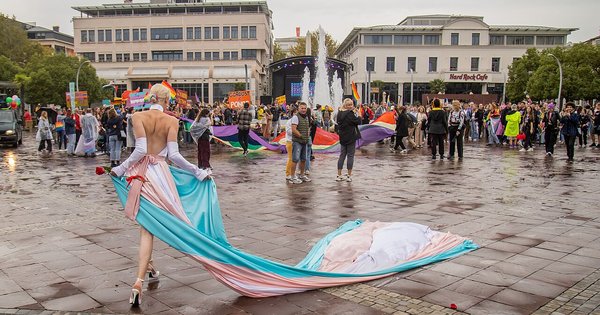
This Saturday, June 20, two Pride parades step off in two Balkan capitals within hours of each other. In Skopje, North Macedonia, marchers gather at the fountain in the City Park and walk a deliberately central route under the slogan “Let Everyone Know.” Roughly 350 kilometers to the northwest, in Sarajevo, the seventh BiH Pride March — Bh. povorka ponosa — moves through Bosnia and Herzegovina’s capital under the banner “All colors look good on us.” Neither set of organizers planned to share the date. But the overlap is worth pausing on, because the two marches, seen side by side, tell you almost everything about where LGBTQ+ life in the western Balkans stands in 2026.
We have not marched in either city this year, but we have spent enough time in the region to know that a Pride parade here is never only a celebration. It is a negotiation with the state over the right to use public space, conducted in real time, on camera, with counter-protesters often a street away. Watching two of them happen on the same Saturday is a useful way to see what these communities have in common — and where their fights diverge.
Same day, different demands
Start with what unites them. Both marches are protest marches first and parties second. Skopje Pride’s published platform names a same-sex partnership law as its top legislative priority; North Macedonia recognizes neither marriage nor civil partnership for same-sex couples. Sarajevo’s organizers carry an even longer list of demands that has stayed remarkably consistent year to year: legal recognition of same-sex unions, a law on gender identity, protection of LGBTIQ+ people from domestic violence, hate crimes written explicitly into the criminal code, and changes to Sarajevo Canton’s law on public gatherings to bring it in line with European standards.
Read those two lists together and a pattern jumps out. Neither country is arguing about the frontier issues that dominate headlines further west — there is no fight here over the fine print of adoption rights or the precise wording of self-identification statutes. The demands are more foundational: recognize that our relationships exist, write down that attacking us is a crime, and let us assemble without negotiating for our safety every single year. That is the actual state of play across much of the western Balkans, and it is why we keep saying this region is one of the most underreported LGBTQ+ stories in Europe.
The route is the argument
The other thing both marches share is an insistence on visibility as the point rather than a risk to be managed. Skopje’s organizers routed this year’s parade straight through the city center — named boulevards, not a discreet loop through a cordoned park — which in a Balkan capital is a statement in itself. Sarajevo, for its part, wrapped its march in a full Pride Week running June 13 to 21, with concerts, workshops, film screenings, drag performances, and guided walks through the city’s queer history, and invited ordinary residents to hang rainbow colors from their balconies.
That invitation to balconies is a small thing that says a lot. It asks the straight majority to take a visible side, in their own windows, in a city where doing so still carries social cost. The contrast with the “stay quiet, stay safe” model that earlier Balkan Prides were pressured into could not be sharper.
The EU backdrop that ties it together
Both countries are EU candidate states, and that is the frame that makes this shared Saturday more than a calendar quirk. Accession negotiations put a country’s human rights record — including how it treats LGBTQ+ people and whether it can protect a peaceful public assembly — under sustained external scrutiny. That does not settle the domestic argument in either capital. Conservative and church-aligned movements remain a real force in both North Macedonia and Bosnia, and the institutions meant to protect minorities are uneven at best. But EU conditionality changes the incentives for governments that might otherwise be tempted to look away when a Pride march is threatened. A state that wants to show Brussels it can guarantee fundamental rights has a concrete reason to actually police the route and protect the marchers.
So when both parades come off peacefully on Saturday — and we very much hope they do — it will not just be two good days in two cities. It will be two governments, both watching the EU watch them, demonstrating something they are increasingly being asked to prove. For the people walking those routes, the stakes are simpler and older: the right to be visible, with dignity, and without fear. On June 20, two capitals will make that case at the same time.
If you want the city-by-city detail, we have written fuller previews of Skopje Pride and the BiH Pride March in Sarajevo. This weekend, read them as two halves of one regional moment.