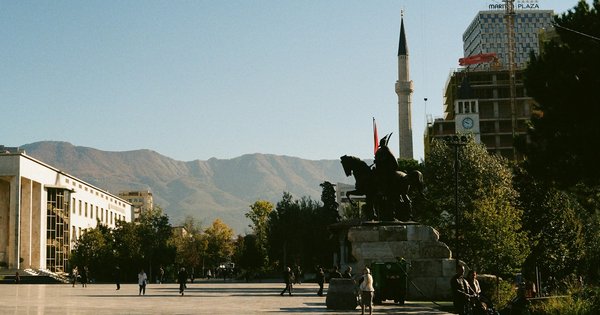
For 150-plus days, Tirana has been the stage for Albania’s biggest protest movement in decades, the so-called Flamingo Revolution. LGBTQ+ activists have marched in it, as we reported in September. Now the government has changed the rules on how anyone in Albania is allowed to gather in public.
On October 28, the Council of Ministers approved a normative act amending Law No. 8773/2001 On Assemblies, Citizens.al reports. A normative act is a decree with the force of law. It takes effect before Parliament votes on it.
None of this is written about LGBTQ+ people. But the law on assemblies is the same one Tirana Pride, feminist marches and every queer vigil depend on. So here’s what changed.
What the new rules do
According to Citizens.al and OCNAL:
- 72-hour bans near institutions. A local police chief, with the prefect’s approval, can ban or restrict gatherings within a perimeter around state, educational or health institutions, if there’s a “real, serious and imminent risk” of violence or property damage. Citizens.al’s legal analysis says the ban can be renewed once, for up to six days in total.
- Appeals don’t pause it. You can go to the administrative court, which has 48 hours to decide. The ban stays in place meanwhile.
- “Protected areas.” Police can order an individual to leave places like stations, ports, airports, schools, hospitals and heritage sites for up to 48 hours if they’re involved in threats, violence or damage. OCNAL notes this can’t be imposed “solely because someone participates in a peaceful demonstration.”
- Tenfold fines. Joining a banned gathering or ignoring a stop order: 10,000–100,000 lek (up from 1,000–10,000). Refusing to disperse while hiding your identity: up to 500,000 lek. Blocking roads: 5,000 lek per person per day.
- Online powers. Police can identify social media accounts, emails and phone numbers linked to calls for violence around an assembly, and ask for content to be taken down. Lawyers told Citizens.al this happens without a court order.
- A new register. A separate government decision creates a State Police database of people referred to prosecutors for protest violence. Border Police can refuse them exit even without a court measure. Data is to be deleted if prosecutors drop the case.
A second act sets up state compensation for businesses damaged during the protests of October 13–22. The state then tries to recover the money, and organisers can be held jointly liable.
Why lawyers are worried
In a Citizens.al analysis, lawyer Dea Nini argues the acts give police control over protests in advance, which clashes with the constitutional standard that organisers only have to notify police. In 2021, Albania’s Constitutional Court struck down a requirement for prior permission to protest. She also points out that “Article 17 prohibits any restriction that undermines the essence of the right.”
Lawyer Irena Dule questions the urgency (“There is neither need nor urgency”) and the vague geography: “The perimeter has no clear boundary.” Her sharpest point is about who gets punished. Making organisers liable for damage they didn’t cause, she says, won’t stop protests: “Protests will not stop, but they will happen without an organiser.”
Why this matters for queer Albanians
Albania’s LGBTQ+ movement has spent years building a habit of showing up in public. Tirana Pride marched on May 23 this year. In December, Tirana hosts ILGA-Europe’s UNSTOPPABLE Pride Organisers’ Summit with Aleanca LGBT, as we covered last week.
Here’s where the new rules could bite:
- Location. Protests that want something from the state tend to go where the state is. As Dule puts it: “A protest against the government is held in front of the Prime Minister’s Office because that is where it is directed.” A 72-hour perimeter ban around those buildings moves the message away from its audience.
- Liability. Small NGOs can’t absorb a damages bill for something a stranger did at the edge of their march. The risk alone can make people think twice about putting their name on a permit notice.
- Data. For LGBTQ+ people who aren’t out at home or work, new police powers to identify accounts and phone numbers are not an abstract worry.
To be clear: so far, no ban has been used against an LGBTQ+ event, and we couldn’t find a public statement on the acts from an Albanian LGBTQ+ group as of this morning. This is about the toolkit, not a specific attack.
What happens next
The act isn’t final. Under Albania’s constitution, Parliament has 45 days to approve it, or it lapses. The President, the Prime Minister, a fifth of MPs, the Ombudsman, or affected individuals and organisations can ask the Constitutional Court to suspend or annul it. Once domestic routes run out, there’s the European Court of Human Rights.
We’ll be watching what Parliament does, and whether Albania’s queer organisers are among those who take this to court.