The countdown is over. Tirana Pride 2026 marched today — Saturday, May 23 — and we marched with it. This is the dispatch we have been writing toward for two weeks, and the strange thing about finally writing it is how ordinary the morning felt. We had coffee. We checked the weather. We walked into the center of the city the way we have walked into the center of this city a hundred times, except today there were a few hundred other people doing the same thing for the same reason.
This was the 13th edition of Pride in Tirana. Thirteen years. That number deserves a moment, because Pride here did not start as a parade at all — it started in 2012 as a bike ride, a deliberately modest, deliberately mobile thing in a country where standing still in one place as an openly LGBTQ+ person was the dangerous part. Thirteen years later it is a march through the center of the Albanian capital, and the people who built it from a bike ride to this did not do it on anyone’s behalf but their own.
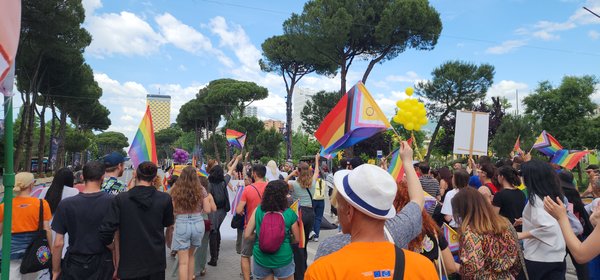
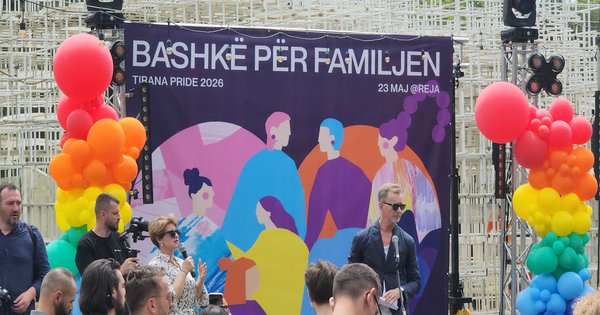
“Together for the Family”
This year’s slogan was Together for the Family — Bashkë për familjen — and it is a sharper piece of messaging than it first looks. Livia Zotrija of Albania’s LGBT Alliance, the organization most people just call Aleanca, framed it plainly in the run-up: the slogan is meant to remind people that no one should have to face fear, prejudice and insecurity alone, and it is a direct answer to a well-worn line of attack. For years the organized opposition to LGBTQ+ rights in this region — and far beyond it — has insisted that queer people are somehow against the family. The slogan turns that around without raising its voice. What threatens families, the banners said in so many words, is violence, hatred, exclusion, and the absence of empathy. Not the people walking today.
We have watched a lot of Pride slogans come and go, and most of them are forgettable. This one is not, because it refuses the defensive crouch. It does not ask permission to exist. It says: families already include us, the only question is whether yours admits it.
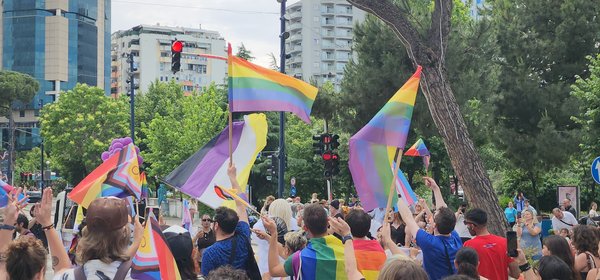
The EU Ambassador speaks
One of the most striking moments of the day came from the stage, where EU Ambassador to Albania Silvio Gonzato delivered a speech that was both personal and political — and deliberately framed as the latter. He opened by making the distinction plain: he was there not because of his personal story, but because of his role representing the European Union.
The theme he returned to was democracy itself. Tying Tirana Pride to the International Day Against Homophobia, Biphobia and Transphobia — whose 2026 theme was “At the heart of democracy” — Gonzato argued that equality is not a side issue but a structural one. Where inequalities and discrimination persist, he said, democracy cannot thrive. Equality is not optional; it is the bedrock of free and resilient societies.
He spoke directly about the EU’s expectations for Albania as it moves through the accession process, making clear that LGBTQ+ rights are not an afterthought in that conversation. He praised the Albanian organizations — Aleanca, Pro LGBT, PINK Embassy — that have built the movement from the ground up, and he named Deputy Prime Minister Albana Koçiu’s presence at the event as a sign of the kind of political engagement the EU wants to see more of.
It was a speech that did what the best diplomatic speeches do: it said the quiet part out loud, in public, on the record. That matters in a country where the civil-partnership law remains parked in parliamentary limbo.
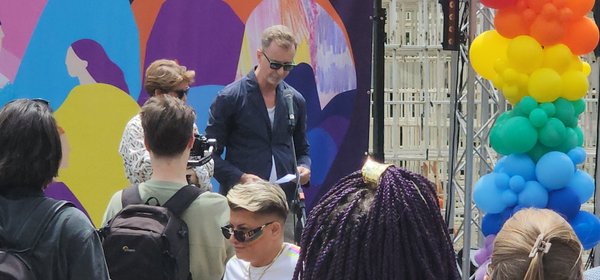
The march itself
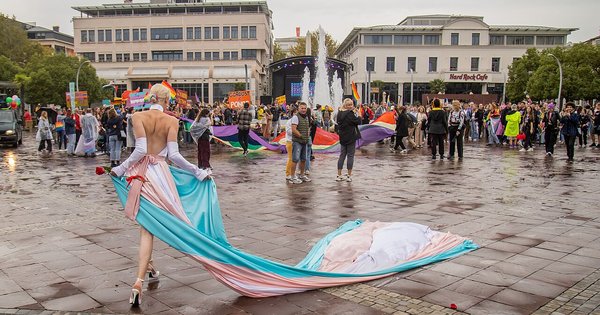
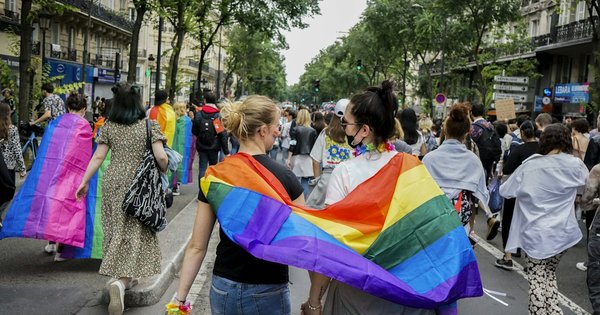
The gathering went the way these things go in Tirana — slowly, then all at once. People drifted into the center in twos and threes, the flags came out of bags, the sound system did its sound-system thing, and then there was a crowd where twenty minutes earlier there had been a meeting point. We took our spot roughly where we said we would all week: a few rows back, behind the coalition banner, near the trans-rights bloc. If you read these dispatches and came to find us, thank you. We meant the invitation.
Police were present and the route was secured, which in Albania is itself a piece of the story. There was a stretch of years when the relationship between Pride and the state ranged from indifferent to hostile. Today the security was professional and the march moved without incident as far as we saw. We are not going to oversell that — a protected march is the floor, not the ceiling, and the unfinished civil-partnership fight is the reminder of how far the ceiling still is. But a city that secures its Pride is a city that has decided, at least officially, which side of this it is on.
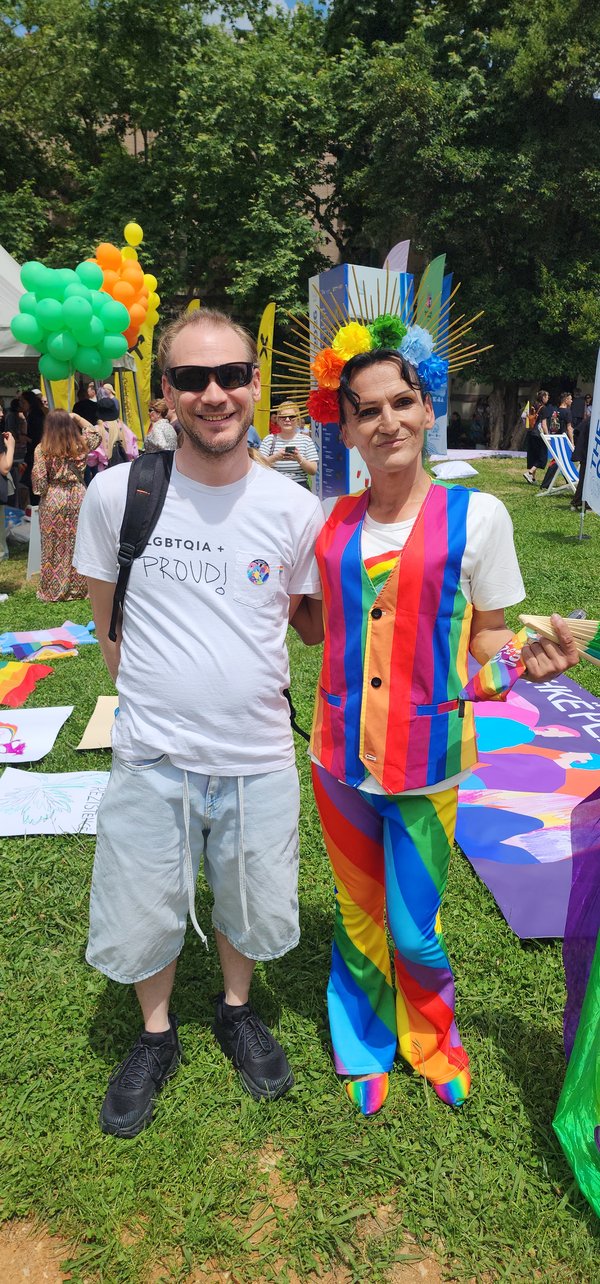
Not marching alone
The other thing worth reporting is that Tirana did not march by itself today, even though it was the only parade physically happening. Organizers here and in Sarajevo, where Bosnia and Herzegovina’s Pride march is set for June 20, coordinated their messaging this year deliberately — a shared statement of solidarity and resilience against a rise in far-right extremism that neither country is imagining. The Balkans are a small region and its queer movements know each other; activists from Tirana will be in Sarajevo next month, and the reverse has been true for years. Today’s slogan was about the family in the intimate sense. The Tirana–Sarajevo link is about the other kind of family — the regional one, the network of people who keep showing up for each other’s marches because they understood early that nobody was coming to do it for them.
After the march
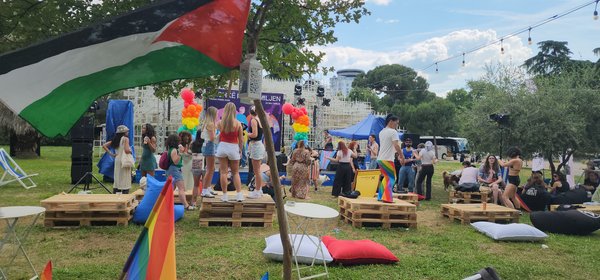
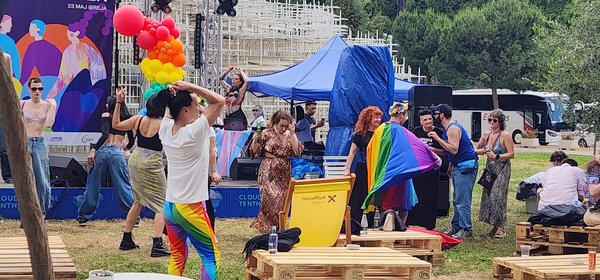
When the march ended, the music started. The festival grounds filled up — people dancing, the DJ sets kicking in, the energy shifting from political to celebratory in the way that Pride does when the speeches end and the speakers come on.
What we are taking home
We have written all week about who was and was not in the room — the thinner diplomatic presence, the EU delegation stepping into the space, the Albanian organizers becoming the center of gravity in their own movement. Today none of that was abstract. The march did not depend on whose flag flew over which embassy. It depended on a few hundred people who decided that walking through the middle of Tirana behind a banner was worth doing, and then did it.
That is the whole report, really. Thirteen years on, in a country still in the slow grind of EU accession, with a civil-partnership law still parked in maddening “within the parliamentary term” language, Pride in Tirana happened again. It was warm. It was loud in the right places and quiet in the right places. And it was, unmistakably, theirs.
We will write once more — a slower piece, in a few days, once the city has gone back to ordinary. For now: it happened, we were there, and it was good.