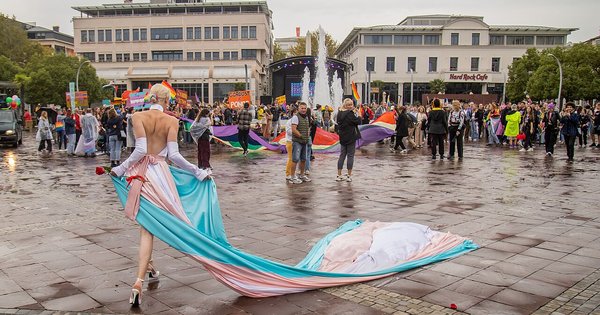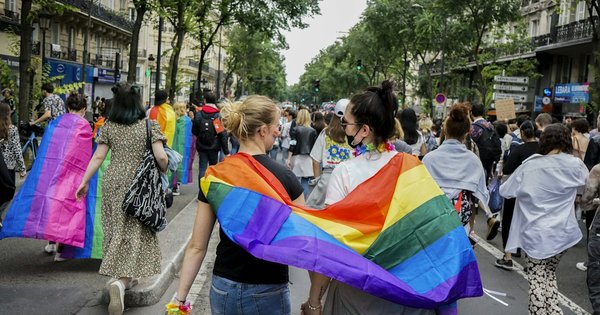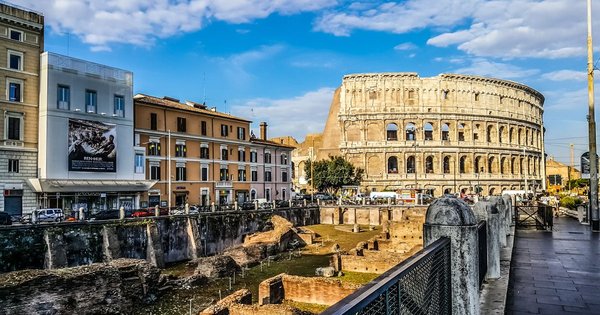
Rome does not do subtle, and neither did Roma Pride. On Saturday, June 20, organizers estimated that more than 300,000 people poured out from Piazza della Repubblica, threaded through the historic center, passed the Colosseum and ended at Piazza Venezia — one of the largest Pride parades anywhere in Europe this year, and one of the most pointedly political.
The theme set the tone before a single float moved: “La Repubblica è di chi la abita” — “The Republic belongs to those who live in it.” It is not a generic Pride slogan about love or visibility. It is a constitutional claim, timed to the 80th anniversary of the Italian Republic, and it borrows the language of the founding charter — freedom, equality, dignity, self-determination — to make a single argument: citizenship and fundamental rights belong to everyone who lives here, LGBTQ+ people included, full stop.
A celebration with an address
That argument has a clear recipient. Italy is governed by Giorgia Meloni’s Brothers of Italy, the most right-wing government the republic has seen in its postwar history, and the relationship between that government and queer Italians has been openly adversarial. The themes Roma Pride chose to foreground — dignity and self-determination — are not abstractions in this context. They are the exact terrain on which LGBTQ+ families have been losing ground.
The flashpoint has been parenthood. Italy does not allow same-sex couples to marry — it offers civil unions, introduced in 2016, but without adoption rights — and recent years have seen a coordinated push to stop municipalities from recognizing both parents of children born to same-sex couples. Some city halls were ordered to stop registering the non-biological parent, leaving children legally tied to only one of the two people raising them. Parliament also moved to treat surrogacy arranged abroad as a crime prosecutable at home, a measure that, whatever one thinks of surrogacy, lands hardest on gay men who became fathers that way. When a Pride march of this size invokes the Constitution and the word “dignity,” this is the lived reality it is pointing at.
Why the scale is the message
It would be a mistake to read Roma Pride as merely a protest, though. The defining image was joy at scale: hundreds of thousands of people, families with kids, drag performers, trade unions, students and pensioners, occupying the symbolic heart of the Italian state for an afternoon. In a political moment designed to make queer people feel like guests in their own country — tolerated, conditional, asked to keep it down — simply filling the route from the Republic’s namesake square to the seat of national monuments is the rebuttal.
That is the quiet genius of tying the march to the republic’s 80th birthday. A government can change the law. It is much harder to argue that the people walking past the Colosseum, waving the same tricolor that flies over parliament, are somehow less of the nation than anyone else. Roma Pride didn’t ask for permission to belong. It asserted belonging as a fact and dared anyone to dispute it in front of 300,000 witnesses.
The wider European picture
Italy’s parade also lands inside a broader European split that is getting sharper, not softer. To the west, Spain just topped ILGA-Europe’s continental rights ranking. To Italy’s own recent past, the trend has been the other direction: pressure on same-sex parents, a hostile national government, and a civil-union framework that stops well short of equality. Italy is a founding EU member and one of its largest economies, and it sits conspicuously behind France, Spain, Germany and the Benelux countries on basic family recognition.
That gap is precisely why a march this size matters beyond the day itself. Numbers are leverage. A 300,000-person turnout in the capital is a standing reminder to Italian lawmakers — and to a European public watching how a major democracy treats its queer citizens — that the constituency for equality is enormous, visible, and not going home quietly. The Republic, as the banners insisted, belongs to those who live in it. On Saturday, an awful lot of them showed up to say so.
Sources: Idealista — Rome Pride 2026, Romeing — Rome Pride 2026, LGBTQ rights in Italy (Wikipedia).