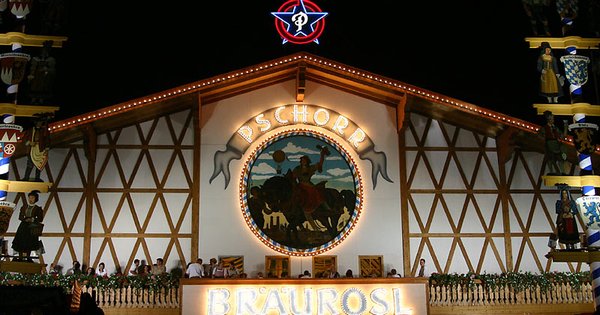
Oktoberfest 2026 opened in Munich on Saturday, and as usual the queer community didn’t wait long to show up. The “Rosa Wiesn” (Pink Oktoberfest) keg tapping at the Käfer beer garden kicked things off on opening day. Today, Sunday September 20, is Gay Sunday, the Rosa Sonntag, when the Pschorr Bräurosl tent becomes the biggest queer gathering of the whole festival. Doors open at 9 a.m., and regulars know the queue starts long before that.
This year there’s something new. For the first time, the Bräurosl is extending its queer weekend into a “Rosa Montag” (Pink Monday) on September 21. Part of that day is Oktoberfest’s first event explicitly for lesbians and FLINTA people (women, lesbians, intersex, non-binary, trans and agender people).
”Where are the lesbian women?”
Gay Sunday has been a Bräurosl tradition since 1977. Franziska and Peter Reichert, who run the tent, told the German Press Agency (dpa) that about 90 percent of the guests are men, and described more than 6,000 men celebrating “life and love” together under one roof.
That imbalance is what the new event is responding to. It’s called “Bier, Boobs, Brezn” (beer, boobs, pretzels), and according to dpa around 700 women and FLINTA people are expected at the Bräurosl on Monday. It’s organised by the team behind the “Lost Girls” party series, working with the podcast “Busenfreundin.”
Organiser Sina Scherer put the question plainly to dpa: where are the lesbian women? She said Munich used to have many more places where lesbians met openly, especially in the Glockenbachviertel, and that many of them have gone. She sees the same thing at the Wiesn, where queer traditions have existed for decades but lesbians have had little visible presence as a community of their own. So the organisers decided to stop waiting for someone else to make room for them and to do it themselves.
Scherer also argued that Oktoberfest works as a venue precisely because it isn’t a queer space. Munich society of every age and background shares the same beer benches. Queer life, she said, should be visible there as a matter of course, and not only in clubs or at CSD (Christopher Street Day, Germany’s Pride).
Berti Gammenthaler of the Forum Queeres Archiv München offered a practical explanation for why queer parties skew male. She told dpa that many lesbian bars of the 1990s and 2000s closed because they couldn’t meet the minimum beer volumes breweries required. She also pointed to the pay gap: a reserved Wiesn table costs real money.
The Reicherts said demand for their queer day has grown every year and now exceeds what one Sunday can hold, which is why they added the Monday. Scherer said the goal isn’t to reinvent Oktoberfest, just to do what people have always done there — sit together, eat, raise a glass, dance and meet people — with lesbians and FLINTA people at the centre for once.
Safety is on people’s minds too. dpa noted that some worry lingers after this summer’s attack on Berlin’s CSD, but also that the mood is to celebrate, with confidence in the festival’s security.
The full queer Oktoberfest calendar
The City of Munich’s official site lists LGBTQ+ gatherings running through the whole festival. Here’s what’s still ahead:
- Monday, September 21, 11 a.m.–4 p.m.: Rosa Montag at the Bräurosl, with an open community gathering from 3 p.m. The first seating needs a reservation.
- Wednesday, September 23, from 6:30 p.m.: Subavaria at Kuffler’s Wine Tent, hosted by Munich’s gay and queer centre Sub. This is its third year. Tables for ten can be booked through Sub.
- Sunday, September 27, from 2 p.m.: Queer skittles at the historic bowling alley in the Oide Wiesn, with drag queens and the “Schwuhplattler” dance troupe. The Oide Wiesn charges €4 admission.
- Sunday, September 27, from 4:45 p.m.: Proud Wiesn at the Armbrustschützen tent, started in 2016 by the BMW Group’s PRIDE employee network and Diversity Tourism. It’s aimed mainly at queer corporate networks and their friends, and requires a reservation.
- Monday, September 28, from 1 p.m.: Prosecco-Wiesn at the Fischer-Vroni, a queer-friendly tradition for more than 30 years. It’s the smallest of the big tents, so arrive early.
- Tuesday, September 29, 5:30–11 p.m.: Rosa Wiesn at the Wildstuben, a ticketed dinner event that started in 2025. Tickets start at €249.
- Sunday, October 4, from 1 p.m.: The traditional queer finale in the hot-food area of the Schottenhamel tent. No registration needed.
Tips if you’re going
Entry to Oktoberfest and its big tents is free. A table reservation isn’t an admission ticket, but it does guarantee you a seat at the busiest events. According to the city, you can simply turn up for the keg tapping, the open area on Gay Sunday, the open part of Rosa Montag, the Prosecco-Wiesn and the closing gathering. You’ll need a booking for reserved areas and the ticketed dinners.
Come however you’re comfortable. Subavaria’s organisers say it plainly: dirndl, lederhosen or everyday clothes are all welcome.
If you’re planning a longer stay, our LGBTQ+ travel guide to Munich covers the city’s queer bars, neighbourhoods and year-round community spaces beyond the Wiesn.
Sources: muenchen.de, “Queer events at the Oktoberfest” (2026 calendar); dpa via news.de, “Bier, Boobs, Brezn – Ein lesbisches Wiesn-Event”; in-muenchen.de, Gay Sunday 2026.