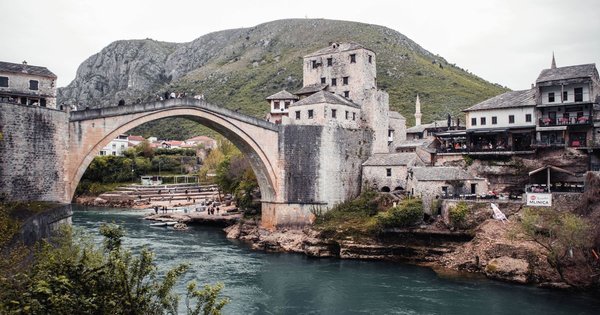
Mostar is one of those places that shows up on every “most beautiful towns in Europe” list, and for once the hype is earned. The Stari Most — the reconstructed sixteenth-century Ottoman bridge arching over the emerald Neretva River — is genuinely breathtaking, and the cobbled old town around it is a maze of coppersmiths, cafés, and stone. We haven’t been to Mostar ourselves yet, so treat this as a researched guide rather than a first-person account, but it’s a city we’ve heard about again and again from fellow travelers criss-crossing the Balkans, and it’s high on our own list.
Here’s what LGBTQ+ visitors should know before they go.
The lay of the land
Mostar sits in Herzegovina, the southern half of Bosnia and Herzegovina, an easy day trip or overnight stop from the Croatian coast (Dubrovnik and Split are both within reach) or from Sarajevo. Most travelers come for the old town: the bridge, the Kujundžiluk bazaar, the mosques, and the ritual of watching local divers plunge from the Stari Most into the river below, a centuries-old tradition that doubles as the town’s signature spectacle.
It’s compact, walkable, and firmly on the tourist trail, which shapes the experience. In the old town you’re surrounded by visitors from all over the world, and the atmosphere is relaxed and used to outsiders.
Where the law and culture stand
Bosnia and Herzegovina decriminalized same-sex activity years ago, and anti-discrimination protections covering sexual orientation and gender identity exist at the state level. But there’s no legal recognition of same-sex partnerships — no marriage, no civil unions — and Bosnian society remains, on the whole, socially conservative. Progress has been slowed by the country’s fragmented political structure, split between the Federation and Republika Srpska.
Mostar carries an added layer of complexity. The city was devastated during the 1990s war and remains, in many ways, socially divided along ethnic and religious lines. That history doesn’t translate into any particular danger for LGBTQ+ tourists, but it does mean this is a more traditional, less cosmopolitan environment than a capital city. Public displays of affection between same-sex partners are best kept discreet here — the same calculus travelers make across much of the region, and arguably a bit more so in a smaller, more conservative town than in a bigger hub.
How it actually feels for visitors
For the ordinary business of being a tourist — wandering the bazaar, eating ćevapi, photographing the bridge, taking a coffee by the river — Mostar is welcoming and easygoing. Bosnians have a well-earned reputation for hospitality, and the town lives on tourism, so visitors of all kinds are a normal sight.
What Mostar doesn’t have is any visible queer scene. There are no gay bars, no dedicated venues, no Pride march of its own. Queer life in Bosnia is concentrated in Sarajevo, where the country’s Pride movement is based — Bosnia held its first-ever Pride March in Sarajevo in 2019, and the capital has hosted one each year since under heavy security. Mostar, by contrast, is a place you visit for its beauty and history rather than its nightlife or community, and LGBTQ+ travelers generally pass through as tourists rather than looking to plug into a local scene.
That’s not a knock on the town — it’s just a realistic expectation to set. Think of Mostar the way you’d think of a stunning historic small town anywhere: a place to soak in for a day or two, with a bit of the situational awareness that traveling in a conservative region calls for.
Practical tips
Most people visit Mostar as part of a wider Balkans or Adriatic itinerary. Buses connect it well to Sarajevo, Dubrovnik, Split, and Mostar’s own small airport sees seasonal traffic, though most travelers arrive overland. The old town is walkable but its cobbles and steps are uneven, so comfortable shoes matter.
Stay a night if you can. The day-trippers pour in from the coast and clear out by late afternoon, and Mostar is at its most magical in the early morning and evening, when the crowds thin and the bridge glows. Bosnia is affordable by European standards, and it sits outside the Schengen zone, which — as with the rest of the country — can make it a useful stop for long-term European travelers managing their Schengen days.
Bring cash for the smaller shops and cafés, respect the town’s mixed religious character (dress modestly when visiting mosques), and if you’re traveling with a partner, calibrate public affection to the setting. Do that, and Mostar rewards you with one of the most beautiful few days you can spend in the Balkans — a city that, whatever its unresolved divisions, keeps drawing the world to its bridge.
Sources: Balkan Insight – Pride marches in Bosnia and North Macedonia, BIH Pride March – Wikipedia, ILGA-Europe Rainbow Map.