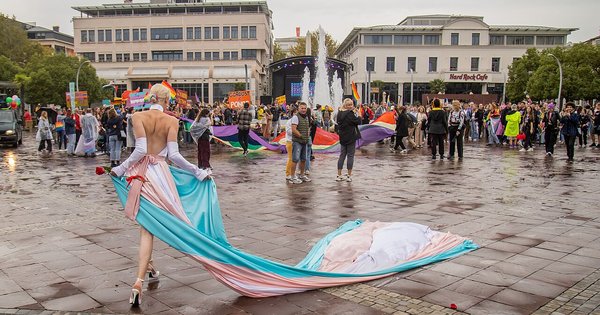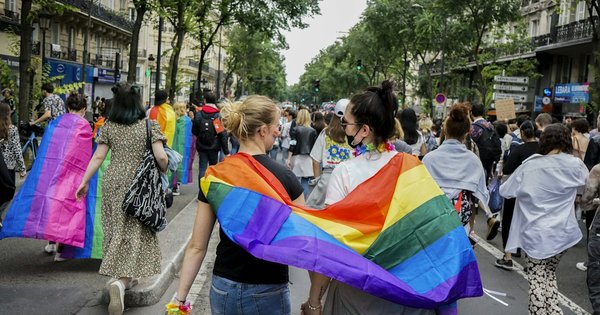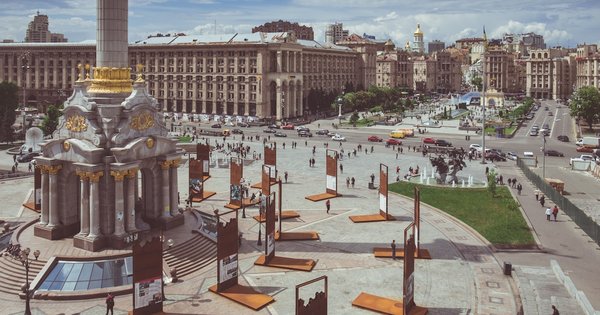
On Saturday, June 21, around 5,000 people walked roughly 1.2 kilometers through the center of Kyiv for the city’s annual Equality March — the largest KyivPride turnout since Russia launched its full-scale invasion in February 2022. The march set off near the Red Building of Taras Shevchenko National University and moved along Taras Shevchenko Boulevard, a route that lasted about two hours before the crowd was dispersed. The reason it ended is the detail that says everything about Pride in Ukraine right now: an air raid alert went out over the capital, explosions were heard, and air defenses were activated. People who had come out to march for their right to exist had to go find shelter from missiles.
That is the texture of this year’s KyivPride, and it is worth sitting with rather than rushing past. For most of the world, a Pride march is a celebration first and a protest second. In Kyiv, the two are inseparable, and the stakes are not abstract. When organizers and participants talk about resilience, they are not reaching for a slogan — they are describing the literal conditions of holding a public LGBTQ+ event in a country under daily bombardment.
”Our families are part of Ukraine”
The framing KyivPride chose this year leaned into that reality. The message running through the day was that LGBTQ+ Ukrainians are not a side issue to be settled “after the war,” but part of the nation defending itself right now — soldiers, medics, volunteers, partners, and parents. Queer and trans people serve in Ukraine’s armed forces, and one of the movement’s central demands has only grown louder during the war: legal recognition for same-sex partnerships, so that a soldier’s partner has the right to be informed if they are wounded, to make medical decisions, to bury them, to inherit. These are not theoretical grievances. They are the things that go wrong, quietly and cruelly, when a couple has no legal standing and one of them does not come home.
Ukraine has taken real steps toward addressing this in recent years: a registered civil partnership bill has been working its way through the system, championed by activists and some members of parliament as both a human rights measure and a wartime necessity. Full marriage equality remains constitutionally blocked during martial law, so partnership recognition has become the concrete, achievable ask — and KyivPride has kept it at the front of the conversation.
A counter-demonstration, and heavy security
As in past years, the march did not happen in a vacuum of goodwill. A counter-demonstration gathered in Kyiv under the banner of “traditional family values,” drawing far-right activists who oppose any expansion of LGBTQ+ rights. The Equality March proceeded under significant police protection, the kind of security footprint that has become standard for Pride events across the region. The Kyiv City State Administration had, ahead of the day, warned of traffic restrictions in the center and urged people to stay clear — the bureaucratic language of a city trying to manage a flashpoint event safely while a war grinds on.
That tension between protection and pressure is familiar to anyone who follows Pride in this part of Europe. What’s notable about Kyiv is that the threat is layered: the homophobia of counter-protesters, the logistical challenge of policing, and above it all the genuine danger of Russian strikes. The march ending under an air raid alert was not a symbolic flourish. It was the war intruding on a day that was already an act of courage.
Why the size matters
Five thousand people is not a huge number by the standards of WorldPride or Madrid’s MADO. But context is everything. In the first years of the full-scale war, security concerns and martial law kept Kyiv’s Pride small, sometimes pushed into safer formats or carried abroad in solidarity events. A turnout of this scale, in the open, in the capital, signals something: that the LGBTQ+ movement in Ukraine has not been driven underground by the war, and that public support for queer Ukrainians has, if anything, broadened as the country reckons with who is actually fighting and dying for it.
There is also the European dimension. Ukraine’s bid for EU membership has put a spotlight on its human rights record, and LGBTQ+ rights — including partnership recognition and anti-discrimination protections — are part of what Brussels watches. Every visible, peaceful Equality March strengthens the case that Ukraine is serious about the values it says it shares with the rest of the continent.
The image to hold onto
It would be easy to let the air raid alert turn this into a grim story. It shouldn’t. The fuller picture is thousands of people choosing to be seen — carrying flags, holding partners’ hands, demanding recognition — in a city where being seen carries real risk, and then calmly heading for shelter when the sirens went off, because that is simply what life requires of them now. They marched anyway. That “anyway” is the whole point of Pride, and Kyiv this year made it impossible to miss.