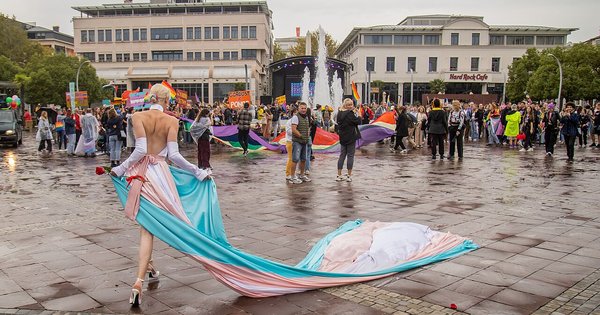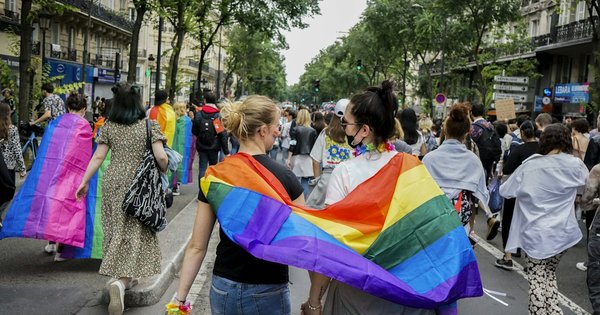
Italy’s Pride season runs longer than most. The country’s Onda Pride network coordinates over fifty individual marches between May and September, from Catania in the south to Bolzano in the north, and the two anchors of the calendar are the same as every year: Roma Pride on the third Saturday in June, Milano Pride on the last Saturday. In 2026 those dates fall on June 20 and June 27. The marches will be the largest LGBTQ+ public gatherings the country sees, and they will run in the only Western European country still without same-sex marriage, in the third year of a government that has spent its time in office moving in the opposite direction.
This is a preview of what to expect — practically, politically, and for anyone planning to be there.
What Pride looks like in Italy in 2026
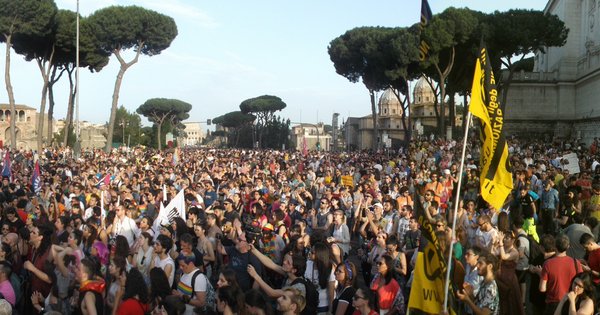
Roma Pride steps off from Piazza della Repubblica on June 20, runs past the Baths of Diocletian and the Imperial Forums, swings past the Colosseum, and ends at Piazza Venezia for the closing rally. The route has changed only at the margins over the last decade. Attendance for the past several years has run between 300,000 and half a million, depending on whose count you believe and what the weather does. The rally lineup has not been announced in full as of this writing, but the organising committee has confirmed that Italian-language drag, trans-led collectives, and family-rights organisations will share the main stage.
Milano Pride a week later is the other anchor. The march on June 27 begins at Via Vittor Pisani, follows the long boulevard of Corso Buenos Aires through Porta Venezia — the city’s queer neighbourhood — and ends at Arco della Pace next to the Castello Sforzesco. Pride Square, the multi-day open-air festival on the Largo Bellintani in front of the Mondadori Building in Porta Venezia, runs from Wednesday June 24 to Saturday June 28 with concerts, panels, and a market.
Outside Rome and Milan, the long Italian Pride season includes Bologna on July 4, Naples on July 11, Florence on July 18, and a string of smaller marches across Sicily, Sardinia, Puglia, and the Alpine north. Onda Pride publishes the full coordinated calendar, and almost every region of the country gets at least one march.
The political backdrop the marches are walking through
It is worth being precise about where Italian LGBTQ+ rights actually stand in 2026, because the gap between the language used by the Meloni government and the legal facts is wide enough to confuse people who do not follow Italian politics closely.
Italy has civil unions for same-sex couples; it has had them since 2016, under the so-called Cirinnà law. Civil unions give most of the rights of marriage, with two large exceptions: joint adoption and stepchild adoption are not allowed, and surrogacy is criminalised. Italy is the only large Western European country that does not allow same-sex marriage, and there is no government bill on the table to change that.
Surrogacy has been the most active area of legislation under the current government. In October 2024 Parliament passed a law making surrogacy a “universal crime” — meaning Italian citizens can be prosecuted in Italy for using surrogacy abroad in countries where it is legal. The penalty runs up to two years in prison and €1 million in fines. The law applies to opposite-sex and same-sex couples alike, but in practice it falls hardest on same-sex couples, because adoption by same-sex couples is not permitted in Italy. The effect for many gay couples who want to be parents is that the legal paths to parenthood are now narrower than they were before this government took office.
Same-sex parents are also navigating a separate front: the Meloni government has instructed municipalities to stop registering both same-sex parents on the birth certificates of children born abroad via surrogacy, and to remove the non-biological parent from existing records in some cases. Several courts have pushed back, including the Bari and Padua tribunals that have ruled the practice unconstitutional. The Italian Constitutional Court is hearing related cases this year.
So when the Roma Pride banners say “Famiglie Arcobaleno” or “Diritti Subito,” they are pointing at concrete legal harms that have happened or are happening now.
What’s worth watching
Three things to keep an eye on across the season:
First, whether the government attempts any new restriction during Pride month itself. In each of the last two years, Family Minister Eugenia Roccella has used the month around Roma Pride to announce a new initiative aimed at “protecting children from gender ideology.” A repeat is possible, and the marches will be the platforms responding to it.
Second, whether the EU dimension shows up. Italy is a founding member of the European Union, not a candidate state, and EU pressure on Rome works differently than it does on Tirana or Belgrade. But there are now infringement procedures, parliamentary questions, and Court of Justice of the European Union cases pending that touch on Italian treatment of same-sex parents and on cross-border family recognition. The Roma Pride stage tends to feature MEPs and EU officials, and they have been getting sharper year over year.
Third, the size of the smaller marches. The story of Italian Pride for the last few years has not been Rome or Milan, which both hold steady. It has been the explosion of small-city Prides in places that did not have one a decade ago — Lecco, Cosenza, Frosinone, Andria. Those are the marches that get organised by twelve volunteers in a country town and end up drawing 5,000 people. They are the part of the season that says the most about where Italian public opinion is going, regardless of what Parliament does.
Practical notes
For travellers, Italy is a straightforward country to be in around Pride. The marches are large and well-policed; counter-protests, where they happen, are usually small and kept at a distance. Rome and Milan in late June are hot and crowded for tourists who have not booked accommodation already, so plan ahead if you are aiming to be there for the parade weekend. Porta Venezia in Milan and the gay-friendly bars around Via di San Giovanni in Laterano in Rome stay open late through the festival week.
The marches are political, and they have been getting more political year over year as the legislative climate worsens. They are also genuinely fun, and that mix — protest plus celebration, frustration plus joy — has been the texture of Italian Pride for as long as it has existed.