There’s a line you hear a lot in the Balkans: being gay is something new, something that came from the West. A team of Bosnian researchers spent four years in the archives to check. Their answer is a 274-page book, and you can read it for free.
Historija kvir života u Bosni i Hercegovini (History of Queer Life in Bosnia and Herzegovina) was published by the Sarajevo Open Centre (SOC) in June 2025. SOC calls it the first publication to comprehensively document the presence, lives and resistance of queer people in the country. October is LGBTQ+ History Month in the US, Canada and beyond, so it felt like the right moment to open it.
What’s in it
The book was edited by musician and researcher Damir Imamović, with co-authors Matej Vrebac, Lejla Kalamujić, Amila Buturović and Nikolina Todorović. It runs in seven chapters, from medieval Bosnia through Ottoman and Austro-Hungarian rule, the interwar Kingdom of Yugoslavia, World War II and socialist Yugoslavia, ending with the first steps of queer activism. Sources include court files, folk songs and tales, travel writing, newspapers and oral testimony, with 105 illustrations, photos and facsimiles. Sweden funded the research.
It’s released under a Creative Commons licence, and the full PDF is on SOC’s site (in Bosnian, Croatian and Serbian).
When the project started in 2021, researcher Nikolina Todorović put its premise plainly: “Bosnia and Herzegovina has its own tradition of queer life” (SOC). Matej Vrebac compared archive work to “looking for a needle in a haystack.” Here are five of the needles they found.
1. Staka Skenderova, Sarajevo’s trailblazer in a man’s suit
Born around 1828 to 1831, Staka Skenderova taught herself to read and write when most people couldn’t, learned Turkish, Russian and German, and represented people in court. According to the book, she was the first woman from Bosnia and Herzegovina to write a book, opened a school for girls in Sarajevo, and became a nun at a time when there were no convents for women there.
To take part in public life in a world that kept women at home, she chose to wear men’s clothing, and she never took it off. She walked into kafanas, a male space, and drank rakija. The authors are careful: they don’t give her a modern label, and they note she never stopped being a woman. But by a definition of queer as anything that resists patriarchal norms, they write, she “could hardly have been anything else.”
The softest part of her story is a friendship. When the English educator Adeline Paulina Irby arrived in Sarajevo, met with suspicion, Staka was the first to defend her before the authorities. Years later, when Staka lost everything, Irby took her in and cared for her. Staka died in 1891 after being hit by a horse carriage at Ilidža, and Irby was at her side that night and paid for her funeral. The book calls their bond one of the most beautiful traces of women’s solidarity in Sarajevo’s past.
2. The “sworn virgins” across the region
Staka wasn’t alone, the book argues. In the mountains of Montenegro, Kosovo, southern Serbia, Albania and parts of Bosnia, some women took on a man’s social role, dressing as men and acting as head of the household. Local words for them included tombelija (from the Turkish for a vow) and virdžina (from the Albanian word for a virgin). It’s a reminder that gender in this region has never been as fixed as some politicians claim.
3. A personal ad in 1923
On July 21, 1923, Sarajevo’s Večernja pošta printed a small ad from an “intelligent young man” looking for a “gentleman” to support him, with a photo left at the newspaper’s office for viewing. It’s the earliest same-sex personal ad the researchers found in Bosnian newspapers.
A rival paper, Jugoslavenski list, pounced the next day and urged the police to track him down. Večernja pošta backpedalled, saying the ad slipped through on a busy Friday. The man they identified was later picked up on the city’s promenade, described as dressed “most elegantly, shimmy from head to toe, powdered, perfumed,” wearing a bracelet. Under the law of the day, dressing like that wasn’t a crime, so he was held for vagrancy instead. More than a hundred years later, the ad reads like an early dating profile written under impossible conditions.
4. A Yugoslav split in 1977
Here’s a fact that surprises a lot of people. After Yugoslavia’s 1974 constitution let republics write their own criminal law, Slovenia, Croatia and Montenegro, plus Serbia’s province of Vojvodina, removed consensual sex between men from their criminal codes in 1977. Bosnia and Herzegovina, the rest of Serbia and Macedonia did not.
That map shaped people’s lives. Bosnian gay men looked west: summers on the Adriatic, trips to Croatia and Slovenia, and contact ads in Croatian and Slovenian magazines, all by post. One Sarajevan told the researchers that replies came from places like Rogaška Slatina and Kumanovo, but “you never know whether someone read it, opened it.” Photos were always requested, he said, and never sent, because that was “really very risky.”
5. From silence to a movement
In Bosnia itself, the book says, the formal decriminalisation came quietly, possibly as early as 1991, right before the war, and was confirmed in the late 1990s when the post-war entities passed new criminal codes. Sources disagree on the exact years, which the authors flag as a reason more research is needed.
Then came the internet, sites like gaybih.com around 2000, and the first LGBTIQ+ group, Udruženje Q, registered in 2004. In 2008 it organised the Queer Sarajevo Festival, which was attacked by far-right groups. SOC itself was founded in 2007, followed by groups like Okvir and Tuzla Open Centre. Today Sarajevo holds a yearly BiH Pride March, and SOC’s lawsuit recently produced a discrimination ruling against Milorad Dodik.
Why this matters now
Across the Balkans, anti-LGBTQ+ campaigns lean on the idea that queer people are foreign. This book answers with dates, names and archive numbers. SOC director Emina Bošnjak puts it in the foreword: “Queer people have always been here,” and the history of queer people “is not a history of the margins, it is the history of a community that others tried to marginalise.”
It’s not the only regional effort to face the past. In Serbia, activists are asking the state for an apology to the men it prosecuted before decriminalisation in 1994.
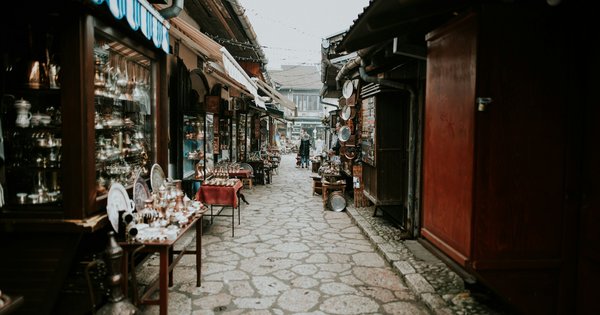
If you’re visiting Sarajevo, walk Baščaršija with this in mind: queer people were in these streets, writing ads, running schools and finding each other, long before anyone marched.
Sources: Sarajevo Open Centre, book page and full PDF; SOC, research launch, 2021. Quotes from the book are TrueQueer translations. Photo: Matej Pribanic / Unsplash.