Same-sex couples have been marrying in Virginia for twelve years. The state constitution still says they can’t.
On November 3, Virginia voters get to fix that. Question 2 on the statewide ballot asks whether to delete the 2006 same-sex marriage ban from the constitution and write in a positive right to marry instead. Early voting is already open, so for a lot of people the decision is happening right now.
Here’s what’s on the ballot, what it changes, and what both sides are saying.
The exact question
This is the wording voters will see, per the Virginia Department of Elections:
“Should the Constitution of Virginia be amended to (i) remove the ban on same-sex marriage; (ii) affirm that two adults may marry regardless of sex, gender, or race; and (iii) require all legally valid marriages to be treated equally under the law?”
It sits between Question 1 on reproductive rights and Question 3 on voting rights.
Wait, isn’t marriage already legal?
Yes. Here’s the short history:
- 2006: Virginians approved the Marshall-Newman Amendment, defining marriage as only between one man and one woman and banning anything that resembles it. It passed with 57% of the vote, 1,328,537 to 999,687, per the official results summarised on Wikipedia.
- 2014: A federal judge struck it down in Bostic v. Schaefer. Same-sex couples have married in Virginia since October 6, 2014, PinkNews notes.
- 2015: The US Supreme Court’s Obergefell v. Hodges made marriage equality the law nationwide, leaving every state ban unenforceable.
- 2020 and 2024: Virginia repealed its statutory bans and then passed a law affirming same-sex marriage, according to the Wikipedia summary of the measure.
So the ban is a dead letter. But it’s still printed in the constitution, and it would matter again if Obergefell were ever weakened or overturned. That’s the gap supporters want to close.
“The outdated ban on same-sex marriage still in Virginia’s state constitution leaves a gap in protections for the thousands of same-sex couples that call this state home,” Equality Virginia executive director Narissa Rahaman told PinkNews.
How it got to the ballot
Changing Virginia’s constitution is slow on purpose: the General Assembly has to pass an amendment in two sessions, with an election in between, before voters see it. Republicans blocked a similar repeal effort in 2022, PinkNews reports. This time it cleared both rounds, and the governor signed House Bill 612, which puts the referendum on the November ballot, Equality Virginia said.
“Twenty years after banning marriage equality, it’s time for our commonwealth to fully complete our evolution,” Rahaman said then.
If it passes, Virginia becomes the fifth state to repeal a constitutional same-sex marriage ban, after Nevada in 2020 and California, Colorado and Hawaii in 2024.
The case for yes
Cardinal News ran two views side by side. Arguing yes, Roanoke Mayor Joe Cobb remembered the day in 2014 when a last-minute federal stay paused marriages: “I stood outside the courthouse in Roanoke, the day before many same-sex couples hoped to get married.” Today, he wrote, he hears from couples “who tell me, plainly, that they’re afraid they might not have the right to if they wait.”
Rob Bookbinder and James Fisher, an Arlington couple married for more than a decade, called it “a critical vote to remove this discriminatory language from the constitution,” PinkNews reported.
The case for no
Arguing no in the same Cardinal News piece, law professor and former Kansas attorney general Phill Kline focused on the word “gender.” He argued that adding it alongside “sex” will create litigation across family law, and wrote that “a suspect class whose membership the member defines is not a classification. It is a moving target.”
Supporters see the wording differently: as a promise that no marriage gets ranked below another.
Your dates
From the Virginia Department of Elections:
- Now through Saturday, October 31: early voting in every locality, including Sundays October 18 and 25 (new this year)
- October 23: last day to register and vote a regular ballot, and to request a mailed absentee ballot
- From October 24: same-day registration, with a provisional ballot
- Tuesday, November 3: Election Day
Why it matters beyond Virginia
Constitutions are where rights go to be hard to take away. Twelve years of legal marriages haven’t erased the 2006 text, and in a year when federal protections for LGBTQ+ students have been rolled back, plenty of couples would rather not rely on one Supreme Court precedent. Virginia is the state of Loving v. Virginia, the 1967 case that ended bans on interracial marriage. Question 2 would put “regardless of sex, gender, or race” into the same constitution. That’s a full circle worth noticing.
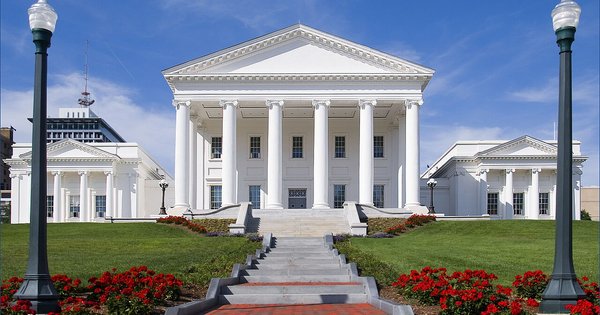
Sources: Virginia Department of Elections and early voting release; PinkNews; Cardinal News; Equality Virginia; Wikipedia: 2006 Virginia Question 1 and 2026 Virginia Question 2. Photo: Ron Cogswell, CC BY 2.0, via Wikimedia Commons.