On Wednesday, a court in Buenos Aires said out loud what lesbian activists in Argentina have been shouting for two and a half years: the fire in Barracas was a hate crime.
Judges of the Tribunal Oral en lo Criminal y Correccional N.º 5 sentenced Justo Fernando Barrientos to life in prison for the murders of Pamela Fabiana Cobbas, Mercedes Roxana Figueroa and Andrea Amarante, and the attempted murder of Sofía Castro Riglos, the only woman who survived, Infobae and the University of Buenos Aires news agency ANCCOM reported on November 18.
What happened in Barracas
On the night of May 5 to 6, 2024, the four women were asleep in a shared room at a family boarding house on Olavarría street in Barracas, in the south of Buenos Aires. According to the prosecution, Barrientos threw a flammable substance into the room and set a mattress alight.
Pamela died first. Roxana died two days later. Andrea died on May 12. Sofía survived with burns and spent about a month in hospital.
Witnesses at the six-month trial described months of insults and hostility toward the women before the attack. Prosecutor Juan Manuel Fernández Buzzi argued that Barrientos harassed them “por ser lesbianas y por ser mujeres”: for being lesbians and for being women, as Infobae reported.
Barrientos denied starting the fire. His public defenders asked for an acquittal, or failing that a conviction for simple homicide, pointing out that no fuel residue was found on his clothes or hands. The court rejected both requests.
What the court decided, and what it didn’t
The judges (Adrián Pérez Lance, Cinthia Oberlander and Juan Manuel Grangeat) convicted Barrientos of aggravated homicide with four aggravating factors:
- hatred of the victims’ sexual orientation (Article 80, subsection 4 of Argentina’s Penal Code)
- cruelty (ensañamiento)
- treachery (alevosía)
- using a means that endangered others
That first one is the headline. According to ANCCOM, it’s the first time an Argentine court has applied the sexual-orientation hate aggravant in a case where lesbian women were killed. “Lesbicide” isn’t its own crime in the Penal Code, so this is how the law can recognise it.
But the court rejected the gender-violence aggravant (Article 80, subsection 11) that the prosecutor and the private complainants had asked for. It also turned down the reparation measures and non-repetition guarantees requested on Sofía’s behalf.
Luciana Sánchez, a lawyer for the complainants including Sofía, said the women were targeted “por ser mujeres y por ser lesbianas” and criticised the court for refusing the reparations, Infobae reported. PinkNews reports that Amnesty International Argentina welcomed the verdict as a historic precedent on lesbicides while criticising the court for leaving out the gender-violence aggravant.
The written reasoning, which will explain those choices, is due on February 19, 2027.
Outside the courthouse
The ruling didn’t come out of nowhere. In 2024 the case was initially not treated as a hate crime; it took a May 2025 appeals court order to make investigators consider a discriminatory motive, according to ANCCOM’s timeline. The Federación Argentina LGBT joined the trial as a collective complainant.
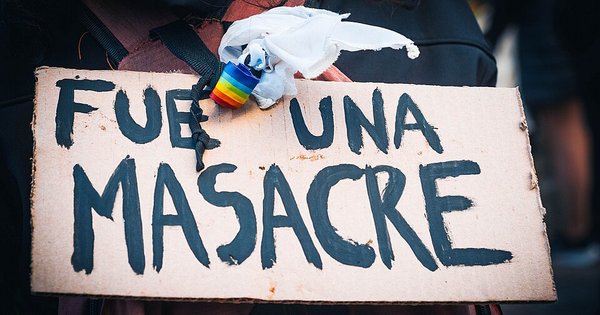
On verdict day, the Coordinadora Lesbicidios Nunca Más gathered feminist groups, LGBT+ collectives and human rights organisations outside the courts on Talcahuano street from 9 a.m. There were Pride and lesbian flags, signs with the four women’s faces, and slogans like “El amor no es odio” (love is not hate) and “Dormir tranquilas no tiene por qué ser un privilegio” (sleeping in peace shouldn’t be a privilege). When the sentence was read, ANCCOM reports, people applauded, cried and sang.
“Queríamos que esta fuera una condena ejemplar e histórica, perpetua con todos los agravantes,” Estefanía Cámera of the Coordinadora told ANCCOM: they wanted an exemplary, historic sentence, life with every aggravant. Delia Colque of Ni Una Migrante Menos said the case would never have got this far without people organising and keeping it visible.
Why it matters beyond Argentina
Violence against lesbians is often filed as something else: a neighbour dispute, a domestic incident, a “crime of passion”. When courts don’t name the motive, it doesn’t show up in the data, and what isn’t counted is easy to ignore.
Barracas now has a conviction that names the hatred. It also leaves a gap: the court didn’t accept that these women were attacked as women too, which is exactly the overlap the word “lesbicide” exists to describe. Activists are already pointing to other open cases.
Sofía, who wasn’t well enough to testify, is still here. The fight over her reparations isn’t finished, and neither is the push to make sure the next case is named correctly from day one.
Sources: Infobae (Nov 18, 2026); ANCCOM, University of Buenos Aires (Nov 18, 2026); PinkNews (Nov 19, 2026). Photo: Gisela Curioni, march in Santa Fe for Pamela, Roxana and Andrea, May 2024, CC BY-SA 4.0, via Wikimedia Commons.