The Balkan Pride season is winding down, and the march that tends to close it is Podgorica’s. Montenegro Pride has settled into October in recent years, with the 2025 edition held on the fourth of the month. Organisers have not yet published a date for 2026 at the time of writing, so anyone planning to travel should watch Queer Montenegro and the Pride organising committee rather than book on the assumption of a particular Saturday.
What is not in doubt is the context the march will be held in, and it is a stranger one than Montenegro’s reputation suggests.
The country that passed the law and then stopped
Montenegro is the only country in the Western Balkans with a same-sex partnership law. Parliament passed the Law on Life Partnership of Persons of the Same Sex in July 2020 by 42 votes to five, it entered into force that month, and it became fully operational a year later. The first life partnership was registered in Podgorica on 25 July 2021.
That is a genuine regional outlier. Draft partnership or civil-union proposals have surfaced elsewhere in the Western Balkans — in Serbia, in Kosovo’s civil code debate, in the Federation of Bosnia and Herzegovina — and none of them has made it into force. For couples in Podgorica, the law means registered status with most of the rights of marriage — inheritance, property, next of kin, social insurance. It does not include joint adoption, which was excluded to get the bill through.
The problem is what happened afterwards, which is close to nothing. The European Commission’s 2025 report on Montenegro flagged the Life Partnership Act specifically, as the trans rights organisation Asocijacija Spektra noted in its response, singling out a law that has been waiting for full implementation for more than five years. Registering a partnership and having every institution that touches your life actually recognise it are different things, and Montenegrin couples have spent half a decade in the gap between them — dealing with registry offices, hospitals, banks and employers that have no established procedure for a status the state created in 2020.
This is the honest assessment the five-year mark calls for. Passing the law was the hard part politically and the easy part administratively. The administrative part never got done.
The law that has never been put to a vote
The larger gap is legal gender recognition, and here Montenegro’s position is worse than stalled.
A Draft Law on Legal Recognition of Gender Identity based on self-determination was introduced in 2024 and has, according to Spektra, passed every required stage of the legislative process, including consultation with the European Commission. In December 2024 the government simply declined to put it on the agenda. It has not been adopted since.
The consequence is not abstract. Without a self-determination framework, trans people in Montenegro who want their documents to match their identity are routed through a medical pathway that includes sterilisation. Spektra puts it plainly: the absence of the law means part of the population is “still forced to go through the process of forced sterilization in order to harmonize their personal documents with their identity.”
The European Commission’s 2025 report identified the unadopted law as an outstanding obligation under Chapters 23 and 24 — the rule-of-law and fundamental-rights chapters that Montenegro cannot close without resolving. It recorded no significant progress in that area. The single improvement it noted in LGBTIQ quality of life was resolved access to hormone therapy for transgender women, which Spektra points out was the product of eight years of its own pressure on institutions rather than a government initiative.
Meanwhile the legal ground beneath the issue keeps shifting in Luxembourg. Recent Court of Justice of the European Union rulings have established mutual recognition of legal gender across member states, extended discrimination protection to cover gender identity, and required states to update identity documents without demanding sterilisation. The EU’s LGBTIQ equality strategy commits the Commission to monitoring candidate countries against exactly that case law. Montenegro is at the front of the accession queue on most measures; on this one it is being measured against a standard that is moving further away from it each year.
What a march is for in that situation
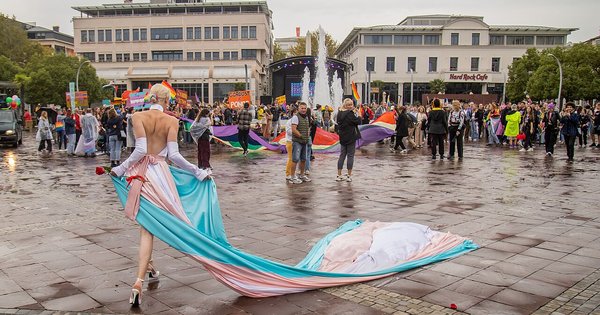
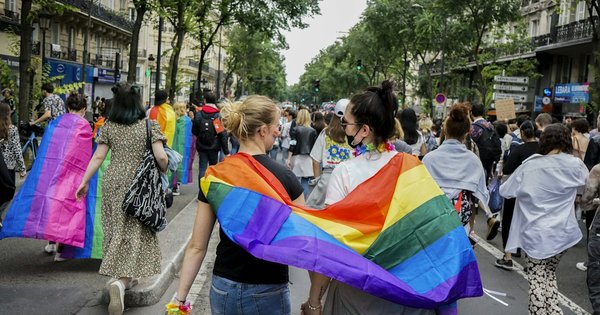
The 2025 Pride marched under the slogan Otpor gradi slobodu — “Resistance Builds Freedom” — starting in front of the Parliament building and moving through central Podgorica. Starting outside Parliament is not incidental. The demands coming out of Montenegro Pride have been legislative for most of the past decade: partnership law first, now self-determination.
That history is worth holding onto when the march looks small. Montenegro’s first Pride, in October 2013, needed 2,000 police officers and still ended with 60 people injured in clashes as extremist groups tried to break the cordon. By 2018 the parade was passing with minimal police escort and no incidents. The shift from riot control to routine policing took five years, and it is the reason the partnership law became thinkable at all.
A brief disclosure, since it will shape our coverage: TrueQueer’s editors relocate to Podgorica in December for an extended stay, which means our reporting on Montenegro over the winter will be from the ground rather than from a distance. The last time they were in the country was 2015, during the protests over NATO accession — Montenegro joined in 2017 — so the comparison will be with a version of the place that no longer exists.
What to watch
Three things will tell you where Montenegro is heading in the next year. Whether the self-determination law is placed on the parliamentary agenda, which is a decision the government can take at any time and has repeatedly declined to take. Whether implementing regulations for the Life Partnership Act finally appear, which would turn a registered status into a working one. And whether the next Commission report records movement on Chapters 23 and 24, because that is the lever with the most weight behind it.
For the marchers in Podgorica in October, none of that will be settled. What the march does is make the gap visible in the one place — outside Parliament, in the capital, in daylight — where it is hardest to ignore.