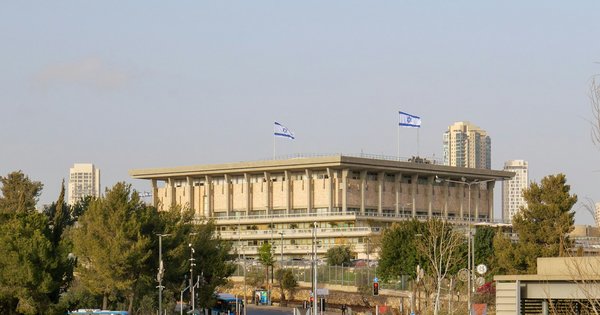
Israel voted on Tuesday, and nobody won. Not yet, anyway.
Exit polls from the October 27 election show neither Prime Minister Benjamin Netanyahu’s bloc nor the opposition bloc led by former army chief Gadi Eisenkot reaching 61 seats, the majority needed in the 120-seat Knesset. Both men claimed victory overnight. Official results are due by November 4.
Last week we laid out what was on the ballot for LGBTQ+ Israelis. Here’s where things stand now, and what the deadlock means for recognition of same-sex couples and for the bills the Aguda warned could return.
The numbers, so far
The figures moved through the night, so it matters whose you read.
- Channels 11 and 13 projected a 51–51 tie between the blocs. Channel 12 gave Netanyahu’s bloc 52 to the opposition’s 49, The Jerusalem Post reports. Earlier in the evening, the three main networks had Eisenkot’s bloc two seats ahead, according to NBC News. Channel 14, which NBC describes as strongly pro-Netanyahu, was the outlier at 60.
- By party (Jerusalem Post): Likud 27, Eisenkot’s Yashar 20–22, Naftali Bennett’s B’Yachad 12–14, the Democrats 9–10, Yisrael Beytenu 7–9, Otzma Yehudit 6–7, Religious Zionism 6, Shas 6 and United Torah Judaism 6–7. The Joint List and Ra’am together were projected at 18–19, a record for Arab parties.
- Turnout was 77.7%, the highest since 1999, with about 5.7 million ballots cast, NBC reports, citing the Central Elections Committee.
The committee itself is cautious: the figures “are preliminary and subject to change as counting and verification continue,” its spokesperson’s office said, per RTÉ.
Who said what
Eisenkot declared that “the public has decided in favor of change,” calling Netanyahu a caretaker prime minister without a mandate, The Jerusalem Post reports. Netanyahu told Likud supporters: “We must form a right-wing, national, strong government,” per NBC.
The night was tense. Eisenkot’s party accused Netanyahu of “laying the groundwork to challenge the results”, and Netanyahu said “they’re trying to steal the election”, RTÉ reports.
Why LGBTQ+ Israelis are watching the maths
Before the vote, The Times of Israel reported that three parties pledged to enshrine LGBTQ equality in law and advance legal recognition for same-sex couples: Yashar, B’Yachad and the Democrats. Likud had no explicit LGBTQ policy.
On the exit polls, those three lists add up to roughly 41 to 46 seats (our sum of the Jerusalem Post’s ranges). That’s a big block, and it’s the core of Eisenkot’s camp. But it’s not 61.
To get there, Eisenkot needs partners, and that’s where it gets hard:
- Yisrael Beytenu’s Avigdor Liberman refused during the campaign to accept a government with, or backed by, Arab parties, the Post notes.
- Opposition leaders have largely ruled out governing with Arab parties, with the Democrats’ Yair Golan the exception.
- Without the Arab parties’ 18–19 projected seats, neither bloc reaches a majority on these numbers.
Netanyahu’s camp has its own problem: on the three main channels’ projections, it sits nine or ten seats short of a majority. His outgoing coalition relied on parties that, The Times of Israel notes, have vocally opposed LGBTQ rights.
What a deadlock means in practice
Here’s the honest read: in the short term, probably not much changes on paper, in either direction.
The process (NBC News): about a week after official results, President Isaac Herzog assigns a lawmaker to form a government. Picking the leader of the largest party is customary but not required. That person gets seven weeks. If they fail, another lawmaker can be tasked, and if the gridlock holds, the Knesset can be dissolved and new elections called within 90 days.
Meanwhile, a deadlock could let Netanyahu stay on as caretaker prime minister while talks run, RTÉ notes.
For same-sex couples, marriage at home still isn’t possible: it’s regulated by the Rabbinate, and many couples marry abroad and then petition for recognition, as JTA explains. A recognition law needs a working majority, and right now nobody has one.
For trans Israelis, the flip side matters too. The Aguda’s pre-election report, summarised by Ynetnews, warned that stalled bills, including one basing sex markers on documents solely on biological criteria and one barring discussion of sexual orientation and gender identity in grades 1 to 8, could come back. Those also need a majority to pass.
The takeaway
Record turnout, a split country, and a long count. The parties that put LGBTQ+ equality in writing came out of this night as a large part of the opposition, which is a real shift from four years ago. Whether that turns into law depends on coalition arithmetic that won’t be settled for weeks.
We’ll report the official results after November 4, and what the coalition talks mean for LGBTQ+ Israelis as they happen.
Sources
- The Jerusalem Post: exit polls, Netanyahu and Eisenkot both fail to win majority (Oct 27–28, 2026)
- The Jerusalem Post: Eisenkot declares victory despite deadlock (Oct 27–28, 2026)
- NBC News: Israel election live updates (Oct 27, 2026)
- RTÉ: Israeli election results in deadlock, exit polls predict (Oct 28, 2026)
- The Times of Israel: Democrats party vows to enshrine LGBTQ equality (Oct 22, 2026)
- Ynetnews: the Aguda report on the outgoing government’s LGBTQ record
- JTA: Jerusalem Pride march turns toward the Knesset (Jun 4, 2026)