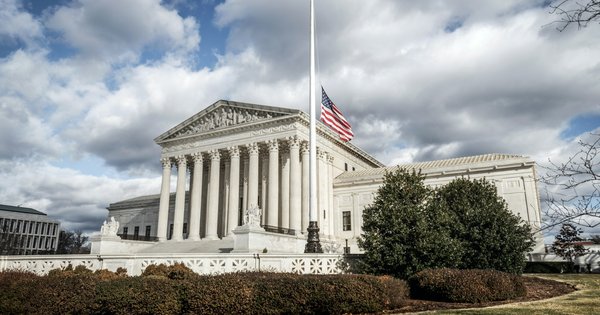
The Supreme Court has said no — at least for now — to the Trump administration’s plan to cut off hormone therapy and other care for transgender people in federal prisons.
In a brief, unsigned order on Wednesday, October 21, the justices denied the government’s emergency request to pause a lower-court order in Trump v. Kingdom. That lower-court order bars the Federal Bureau of Prisons (BOP) from enforcing its 2026 policy on care for trans inmates. The Court gave no reasons. Justices Samuel Alito and Clarence Thomas noted, without explanation, that they would have granted the administration’s request, SCOTUSblog reports.
At a court with a 6–3 conservative majority, NBC News called it a rare recent win for transgender advocates.
What the policy would have done
The BOP adopted the policy in February 2026. According to NBC News, it would stop gender transition surgery, hormone treatments and “social accommodations” such as wigs, padding and makeup. Trans people in custody would be left with mental health services and possibly medications such as antidepressants.
The Washington Blade adds that it would require staff to use legal names or pronouns matching biological sex, bar funds for what it calls “items that align with transgender ideology,” and suspend clothing, pat-search and support accommodations.
The policy follows President Trump’s January 2025 executive order directing agencies to recognize only male and female. The BOP’s 43-page memo said earlier policies relied on recommendations from the World Professional Association for Transgender Health, which prison administrators deemed “unreliable,” per SCOTUSblog.
Who it affects
About 1,000 transgender people are in federal custody, NBC News reports. The plaintiffs told the courts the abrupt change would end treatment for nearly 1,000 people, according to the Blade.
The lead plaintiffs — Alishea Kingdom, Jas Kapule and Solo Nichols — have received hormone therapy for years. The ACLU, which represents them, says the BOP has provided hormone therapy to inmates since 1992.
We covered an earlier stage of this case in June, when the court certified the class and extended its injunction.
How it got here
- Earlier in 2026: Senior U.S. District Judge Royce Lamberth, a Reagan appointee in Washington, blocked the policy. He found the BOP’s stated reasons were pretextual and wrote that the government cited “zero evidence from its own medical or mental health professionals,” NBC News reports.
- August 26: Lamberth issued his most recent order barring the 2026 policy.
- September: A divided 2–1 panel of the D.C. Circuit refused to freeze it.
- September 28: The administration asked the Supreme Court to step in. Solicitor General D. John Sauer argued the lower court was “substituting its own policy judgment for that of the agency.”
- October 8: The inmates replied that the government was asking the Court “to overturn a three decades-long status quo,” and warned that “withdrawing care will cause significant changes to their bodies.”
- October 21: The Supreme Court said no.
What people are saying
“This is a critical ruling for our clients and all transgender people in Bureau of Prisons custody,” ACLU lawyer Li Nowlin-Sohl told NBC News.
Human Rights Campaign President Kelley Robinson said: “Today, trans people in federal prisons can keep getting the care they need,” per the Blade.
White House spokeswoman Allison Schuster called the order “a loss for common sense.” A BOP spokesperson told the Blade the updated policy is “rooted in medical guidance.”
What this is — and isn’t
This is an emergency-docket decision, not a final ruling on whether the policy is legal. The case goes back to the lower courts, where the fight over the policy will continue. The plaintiffs argue it lacks a reasoned explanation under federal administrative law and violates the Eighth Amendment’s ban on cruel and unusual punishment.
It also lands against a tough backdrop. As NBC News notes, this same Court upheld state bans on trans athletes in girls’ and women’s sports in June, upheld state bans on gender-affirming care for minors in 2025, and let the administration enforce its ban on trans military service.
That’s what makes this order matter. Incarcerated trans people are among the least visible people affected by the administration’s gender policies, and the harm of losing care is immediate. For now, roughly a thousand people keep the treatment they’ve had — some of them for years.
Sources: SCOTUSblog; NBC News; Washington Blade.