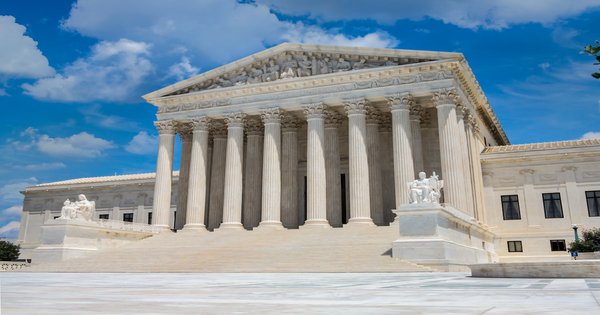
Back in May we wrote that two quiet cases had been sitting on the Supreme Court’s docket since the winter, and that when they landed they would reach far beyond the two young athletes whose names were on them. On June 30, they landed. By a vote of 6 to 3, the Court held that states may bar transgender girls and women from girls’ and women’s school sports teams — and that doing so violates neither Title IX nor the Constitution’s Equal Protection Clause.
What the Court decided
The two cases — West Virginia v. B.P.J. and Little v. Hecox — were argued and decided together because they ask the same question: can a state categorically exclude transgender girls from female sports teams? West Virginia’s law had been challenged by Becky Pepper-Jackson, who has been on puberty blockers and wanted to run cross country; Idaho’s by Lindsay Hecox, a trans woman who wanted to try out for her university’s team. Both were represented by the ACLU.
Justice Brett Kavanaugh wrote for the majority. The core holding is that schools may base eligibility for girls’ and women’s teams on biological sex, and that drawing lines this way does not amount to unlawful discrimination under either the education law or the Fourteenth Amendment. In the majority’s framing, sex-separated sports are permissible precisely because they distinguish on the basis of sex, and a state’s decision about who counts as female for that purpose falls within its authority.
What it did not decide — and why that still matters
It is worth being precise, because precision is the difference between despair and strategy. The ruling directly concerns only West Virginia and Idaho. But roughly two dozen other states have materially similar bans on the books, and this decision removes the strongest federal legal argument against them. In practical effect, it green-lights those laws too.
The decision is also narrower than the broadest thing the Court could have said. It is about eligibility for sex-separated athletic teams. It is not, on its face, a ruling that transgender people are owed no constitutional protection anywhere, and it does not directly resolve the many other fights underway — over gender-affirming care, identity documents, bathrooms, or the military. But no one should mistake a narrow holding for a friendly one. Coming from a Court that in recent terms has already upheld state bans on gender-affirming care for minors, this is another data point in a clear direction, and lower courts will read it as a signal well beyond the sports context.
The dissent
The three dissenting justices argued that the bans do exactly what equal-protection doctrine is supposed to forbid: single out a group defined by a protected characteristic and shut its members out of a public benefit. Under Title IX, the dissent’s view is that excluding a girl from a girls’ team because she is transgender is discrimination “on the basis of sex” in the most literal sense the statute allows. That reasoning did not carry the day, but it is the argument that will anchor the next decade of litigation and legislative fights.
What this means on the ground
For a transgender teenager in one of the affected states, the immediate consequence is blunt: the team is closed. Sports are not a side issue for adolescents — they are where friendships, belonging, and the ordinary business of growing up happen, and being told you cannot participate is a specific and lasting kind of exclusion. That is the human center of this, underneath the doctrine.
For everyone watching from outside the US — including the many LGBTQ+ Americans now living in Europe, ourselves included — this is another entry in a widening gap. On the same day the New Jersey legislature was moving to strengthen shield-law protections for gender-affirming care, the country’s highest court was narrowing the constitutional floor beneath trans young people. The United States is not moving in one direction. It is splitting, hard, along state lines, and the Supreme Court has now made the map that much starker.
We said in May that it was worth understanding these cases before they landed rather than after. Now that they have, the task shifts: understanding not just what was lost, but where the fight goes next. On the evidence of the dissent, and of the state legislatures still building protections, it is far from over.
Sources: SCOTUSblog — Court rules states can exclude transgender athletes, ACLU response to the ruling, CBS News.