Serbia is one of the harder countries in the Western Balkans to summarise in a sentence, because the headline facts pull in opposite directions. It is a country that had an openly lesbian prime minister for seven years. It is also a country where two people of the same sex have no way to register their relationship — no marriage, no civil partnership, nothing. Both of those things are true in 2026, and the distance between them is the most useful thing to understand about LGBTQ+ rights in Serbia.
Where the law stands
The legal baseline is better than outsiders often assume. Same-sex sexual activity has been legal in Serbia since 1994. The country’s anti-discrimination framework, anchored by the 2009 Law on the Prohibition of Discrimination, explicitly covers sexual orientation and gender identity, and Serbia has a Commissioner for the Protection of Equality whose office handles complaints. Legal gender recognition is available, and Serbia changed its rules years ago so that it no longer requires sterilisation — a standard that several wealthier European countries took longer to meet.
So the problem is not that Serbia lacks LGBTQ+ law. The problem is concentrated almost entirely in one place: relationship recognition.
Serbia’s 2006 constitution defines marriage as a union between a woman and a man, which forecloses same-sex marriage without constitutional change. That alone would not be unusual in the region. What makes Serbia stand out is what happened with the alternative. A draft law on same-sex partnerships was prepared in 2021, modelled on registered-partnership frameworks elsewhere in Europe, and it had real momentum inside the government. It did not become law. President Aleksandar Vučić publicly signalled he would not sign it, citing the constitution, and the bill stalled. It has not advanced since.
That is the gap. Serbia has the institutional machinery to recognise same-sex couples and has, at various points, drafted the exact instrument to do it. The recognition has simply not been allowed to land.
The Brnabić paradox
No discussion of Serbia avoids Ana Brnabić, and it should not. Brnabić served as Serbia’s prime minister from 2017, the first openly gay person and first woman to hold the office, and later moved into a senior role as Speaker of the National Assembly. Her tenure was historic by any measure of visibility.
It also produced very little for LGBTQ+ Serbians in terms of concrete rights. The partnership law stalled on her government’s watch. Activists in Belgrade have been candid, and sometimes sharp, about this: representation at the top of government did not translate into protections at the level of ordinary couples, and a head of government who is herself gay did not change the political cost-benefit calculation that keeps the partnership law shelved.
This is worth sitting with, because it is a useful corrective to a comfortable assumption. Visibility is not the same as power, and a single prominent figure is not a movement. The people doing the load-bearing work for LGBTQ+ rights in Serbia are the organisations and the marchers, not a single office-holder.
Belgrade Pride and EuroPride
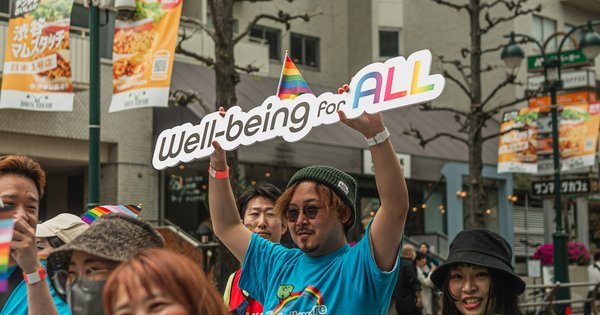
The most resilient institution in Serbian LGBTQ+ life is Belgrade Pride. Its history is genuinely violent — the 2010 march was attacked by thousands of counter-protesters, and Pride was effectively banned from 2011 to 2013 on “security” grounds. Since 2014 it has been held every year. That continuity, hard-won, is real progress.
The stress test came in 2022, when Belgrade hosted EuroPride. The Serbian government tried to cancel it, then attempted to restrict it; the march ultimately went ahead on a shortened, heavily policed route. The episode was a precise illustration of Serbia’s pattern: the state does not forbid LGBTQ+ visibility outright, but it negotiates it down, contains it, and reminds everyone who controls the route. Belgrade Pride continues into 2026, planning its march and issuing its call for community proposals, and recent editions have moved in step with the broader wave of student-led protest that has reshaped Serbian politics.
The EU accession lever
Serbia has been an EU candidate since 2012, and accession negotiations are the single biggest external pressure point on LGBTQ+ rights. The European Commission’s annual progress reports consistently flag the absence of same-sex partnership recognition and the persistence of hate speech and discrimination. ILGA-Europe’s Rainbow Map, which the Commission cites, places Serbia in the middle-to-lower band of European countries — protected on paper, exposed in practice.
The complication is that Serbia’s overall accession path has slowed, tangled up in rule-of-law concerns and the country’s relationship with Russia. When accession stalls, the EU’s leverage on LGBTQ+ rights stalls with it. That is the quiet bad news for Serbian activists: the most reliable engine of progress in the Western Balkans is currently idling.
Reading Serbia honestly
It would be wrong to call Serbia a hostile country for LGBTQ+ people and wrong to call it a safe one. It is a country with decent law, a durable Pride, a society that is slowly shifting, and a political class that has decided relationship recognition is a fight not worth having. The activists carrying it forward know exactly which of those facts is the obstacle. For anyone watching the Balkans, Serbia is the case study in how far visibility can travel without rights — and how much work still sits between the two.