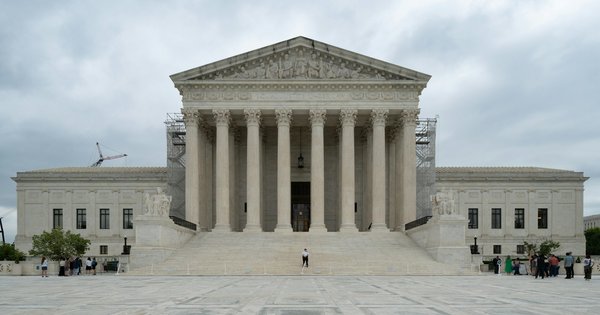
Here’s the question the Supreme Court heard on November 3: if a state pays for universal preschool, can a religious school take that money and still turn away children because their parents are gay?
Going by the oral arguments, a majority of the justices seemed inclined to side with the schools.
The short version
- The case: St. Mary Catholic Parish v. Roy, argued Tuesday, November 3, 2026.
- The dispute: Two Catholic preschools want to join Colorado’s state-funded universal preschool program but don’t want to follow its nondiscrimination rules, which cover sexual orientation and gender identity, Chalkbeat reported.
- The lean: A majority appeared likely to side with the Catholic schools, according to Colorado Politics.
- When we’ll know: A ruling is expected by the end of June 2027.
What the case is actually about
Colorado offers state-funded preschool through a program with more than 2,000 participating preschools, including religious ones that agreed to the nondiscrimination rules. The state requires schools in the program to admit any child.
The Catholic preschools argue that admitting families who don’t follow Catholic teaching would mean sacrificing their beliefs, violating their First Amendment rights. Colorado’s central worry, per Colorado Politics, was that the schools would turn away children of same-sex couples. The schools’ lawyer said they have no blanket rule against admitting those children.
Lower courts, including the federal appeals court, sided with Colorado. They leaned on Employment Division v. Smith, a 1990 precedent that says the Free Exercise Clause doesn’t exempt people from neutral, generally applicable laws. Several conservative justices questioned relying on it here. We explained that background when the Court took the case in April.
What the justices said
The conservative side sounded skeptical of Colorado.
- Justice Brett Kavanaugh questioned why the state was fighting when thousands of other preschools are available, telling Colorado’s Deputy Solicitor General Helen Norton: “It seems like this would be a solution in search of a problem that is unnecessary to create this clash.” He also noted the program allows single-gender schools, according to Colorado Politics.
- Justice Clarence Thomas asked why the Court would rely on Smith when it hadn’t in recent religious liberty rulings.
- Justice Samuel Alito, a vocal critic of Smith, argued a neutral rule can still burden religion, using the example of a slaughter rule that would outlaw kosher and halal slaughterhouses, Chalkbeat reported.
The liberal justices pressed the schools.
- Justice Sonia Sotomayor asked: “Your Catholic schools will reject a child merely because their parents are homosexual?” The schools’ lawyer, Nick Reaves, replied that if it was the preschool’s “sincere religious exercise,” that would be permitted.
- Justice Ketanji Brown Jackson asked whether the same logic would let religious schools exclude children of other protected groups, such as a particular race. Sarah Harris, a Justice Department lawyer arguing for the schools, said that argument would likely lose because the government has a compelling interest in preventing racial discrimination.
- Justice Elena Kagan noted that the Court’s three recent religious-school wins involved rules that explicitly treated religious schools differently, which she said isn’t the case in Colorado.
What Colorado argued
Norton told the Court the state’s interest is “equal opportunity, not some opportunity.” Families are harmed when they’re turned away from a publicly funded school, she argued, because that school may be the only one that fits a parent’s work schedule or location. She gave the example of a parent who needs a school that opens at 7 a.m. to catch a bus to work, according to the Human Rights Campaign.
HRC President Kelley Robinson put it simply: “Exclusion has no place in our educational system.”
Why this matters beyond Colorado
This is about more than a few dozen preschools. Chalkbeat reports the ruling could shape the conditions states can attach to public money for religious schools across the country. A loss would also be Colorado’s fourth major First Amendment defeat at the Supreme Court in the past decade, Colorado Politics noted.
If the Court rules for the schools, HRC warns, other religiously affiliated schools in public programs could deny or withdraw admission based on a parent’s sexual orientation or gender identity.
The timing is striking. A week ago, US voters sent a rainbow wave of LGBTQ+ candidates to office. But the Supreme Court isn’t on the ballot, and this decision, likely in June, could redraw where public money meets LGBTQ+ families for years.
What to watch
- The opinion, expected by the end of June 2027.
- Whether the Court narrows or overturns Smith, which would ripple far beyond schools.
- How states respond. A ruling for the schools could push states to rethink how they fund and regulate private providers.
Oral arguments aren’t rulings, and justices sometimes surprise. But LGBTQ+ families in Colorado and beyond have good reason to pay attention this spring.
Sources: Chalkbeat Colorado (Nov 3, 2026); Colorado Politics (Nov 3, 2026); Human Rights Campaign (Nov 3, 2026). Photo: Tomasz Zielonka / Unsplash.