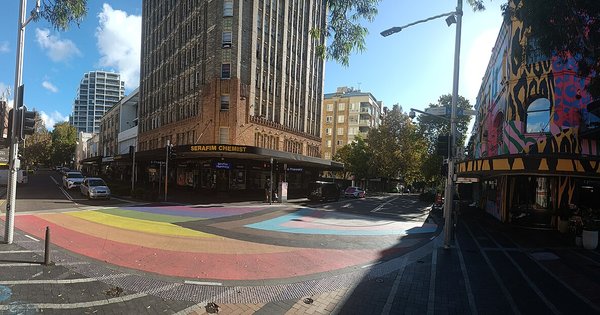
Around 15 officers from the Surry Hills Police Area Command moved through Darlinghurst on Saturday night, walking the queues outside Oxford Street’s LGBTQ+ venues, entering them, and conducting drug searches inside. Patrons at Kinselas, ARQ and the Colombian Hotel all described the same scene.
“My friend and I watched around 15 police walk up and down the lines in front of ARQ at about 11:30,” one patron told the Star Observer. “They also went into the venue. It was super stressful for the venue staff just trying to put on a party. It’s a Saturday night, it’s ridiculous that so many police are on Oxford Street for any reason.”
Police searched 65 people over the course of the operation and recorded 28 drug detections. No charges were laid. No arrests were made.
Three months after the last one
This is not a one-off, and that is the part the community is reacting to.
NSW Police ran a near-identical operation on the same strip in June. Witnesses described that raid as unprofessional and aggressive, and it is currently the subject of an open misconduct investigation by the Law Enforcement Conduct Commission, the state’s police oversight body. The LECC has ordered NSW Police to reinvestigate the conduct involved.
Doing it again, in the same precinct, while that investigation is live, is what has turned a routine complaint into something angrier.
“Carrying out these intimidating raids while the NSW Police are already under orders from the Law Enforcement Conduct Commission to reinvestigate identical police misconduct from June, is unacceptable,” said Timothy Roberts, president of the NSW Council for Civil Liberties. “Doubling down on these tactics shows a clear lack of respect for the community. Targeting marginalised communities under the guise of safety only hurts Sydney’s nightlife and destroys whatever public trust is left.”
NSW Police described the operation to media as “intelligence-led” and “prevention-focused,” aimed at reducing “violence, crime, and fear.”
The numbers don’t support the stated purpose
Sixty-five searches producing 28 detections and zero charges is a set of figures that describes recreational possession, not supply. If the objective is disrupting a drug trade, the objective is not being met, and the mismatch between the stated purpose and the observable result is the core of the community’s argument.
There is also a harm reduction case against the method itself, which predates this particular raid by years. Drug detection dogs, deployed at venue entrances and in queues, have been repeatedly criticised by legal and health organisations for producing exactly the behaviour they are meant to deter — prompting people who spot the dogs to swallow everything they are carrying at once rather than be caught with it. The risk profile of panic consumption is considerably worse than the risk profile of the original dose.
Others have raised the comparison question. A volunteer with a harm minimisation service that works in Sydney’s more heterosexual nightlife precincts told the Star Observer they had spent the same Saturday night in Darling Harbour watching groups of men surround and intimidate young women, make jokes about rape and domestic violence, and threaten to punch a woman who rejected them — with, in their account, minimal police presence.
Why Oxford Street specifically
Oxford Street has been the centre of gay and lesbian Sydney since the 1970s. It is where the bars were when the bars were illegal, and it is the route the first Mardi Gras took in June 1978.
That march ended in violence. Fifty-three people were arrested, many of them beaten in police custody, and the Sydney Morning Herald published the names, addresses and occupations of those arrested — at a time when NSW had no anti-discrimination protections on sexual orientation, and homosexuality itself would remain a criminal offence in the state until 1984. Some of the people on that list lost their jobs. The survivors of that night are still known in Sydney as the 78ers, and NSW Police formally apologised to them in 2016.
The distance between 1978 and now is real, and worth acknowledging. It is also shorter than it looks. In December 2023, the Special Commission of Inquiry into LGBTIQ hate crimes delivered its final report after examining unsolved suspected hate crime deaths of LGBTIQ people in NSW between 1970 and 2010. It made 19 recommendations, including fresh inquests into several deaths, and its findings on how those cases were originally investigated were not flattering to the force.
That is the history sitting underneath a line of officers outside ARQ on a Saturday night. It does not mean every officer on Oxford Street is acting in bad faith. It does mean that an institution with this record does not get to treat “we were just doing drug searches” as a neutral statement in this particular postcode, and that the burden of explaining is on the police rather than on the people in the queue.
What happens next
The June operation’s LECC investigation remains open, and its findings will now be read against a second raid that took place while it was underway. Sydney’s venue operators, already navigating a nightlife economy that has been contracting for a decade — the Colombian Hotel is currently on the market — are absorbing another Saturday night of disrupted trade.
The immediate question for NSW Police is a simple one, and it is being asked by patrons, by civil liberties lawyers and by the venues themselves: if this is about supply, why does the operation keep producing detections and no charges? Until that has an answer, the community’s reading of what happened on Oxford Street on Saturday night is going to be the one that sticks.