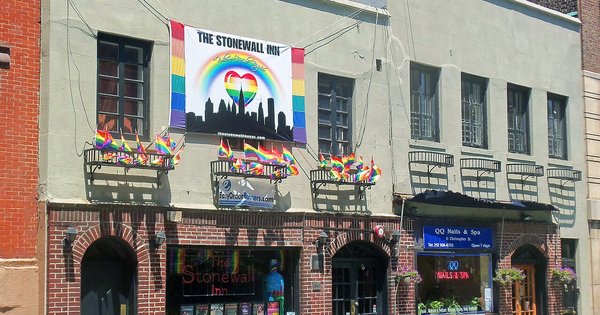
Most heads of government spend UN General Assembly week moving between bilateral meetings and receptions in Midtown. On Monday evening, September 21, Dutch Prime Minister Rob Jetten went downtown to the Stonewall Inn in Greenwich Village and ordered a beer.
Jetten is the first openly gay person to lead the Netherlands. According to reporting by WABC-TV and LGBTQ Nation, he spoke at the bar with co-owner Kurt Kelly about the 1969 uprising, when patrons fought back against a police raid carried out under the city’s anti-gay laws. Pride marches around the world still commemorate that night.
“We stand on the shoulders of great people that, here, started this fight for equal rights,” Jetten said, according to WABC. He added a caution: “You have to understand that the emancipation of a community will never stop, and you have to be aware of what the new threats for our community will be.” He also said: “Historical grounds like these are important, and we will make sure we’ll never give up.”
In a post on his official prime minister’s account, Jetten described Stonewall as more than a gay bar in New York. He called it the place widely seen as the starting point of global LGBTIQ+ emancipation and activism, and noted that it is now a national monument.
A warning aimed at the Netherlands
The photos from the bar were warm. What Jetten told Dutch journalists afterwards was more sobering.
According to NL Times, citing the Dutch news agency ANP, the prime minister said the rights of the whole queer community are under pressure around the world, and that this includes the Netherlands, where he said acceptance of LGBTQI+ people is declining rapidly. He said he felt a personal commitment to showing the younger generation “You are allowed to be yourself, even in the Netherlands.”
“You can see that in countries where LGBTI rights are attacked first, many other rights of other minorities often follow,” he said at Stonewall.
He was not speaking in the abstract. The same week, a report by the Trimbos Institute and Utrecht University found that Dutch secondary school students have become markedly more negative about homosexuality. Over the past four years, the share of boys with a positive attitude fell from 40 percent to 22 percent, according to NL Times. Among girls it dropped from 78 percent to 51 percent.
Judith Tielen, the VVD state secretary responsible for education and emancipation, told the Tweede Kamer on Tuesday that the cabinet is considering additional measures. She said she wants to commission more research so the government can design a more targeted response.
That will sound familiar to anyone who followed WorldPride Amsterdam this summer. In August, Tielen publicly acknowledged that Dutch progress on LGBTQ+ equality had stalled. The Netherlands became the first country to open civil marriage to same-sex couples in 2001, but 25 years later the new data suggests that legal equality has not guaranteed acceptance among teenagers.
Raising it at the UN, and with Trump
Jetten’s trip comes as LGBTQ+ rights are being openly contested at the UN itself. In his address to the General Assembly, US President Donald Trump attacked UN human rights officials for criticising his administration’s policies on transgender young people. NL Times reported that Jetten met Trump before the speech and raised LGBTI emancipation and people’s freedom to be themselves.
The Dutch leader’s week also included a Monday night reception hosted by the LGBTQ Victory Institute, which supports openly LGBTQ+ candidates. The group’s CEO, Evan Low, called Jetten a reflection of the importance of representation. “You can’t be what you can’t see,” Low said, as quoted by LGBTQ Nation. NL Times reported that later in the week Jetten and New York Mayor Zohran Mamdani were due to visit community centres working on social cohesion across differences in background and sexual orientation.
What Jetten has promised
Jetten, 39, became the youngest prime minister in Dutch history earlier this year, leading a coalition that has drawn criticism from the left over its planned welfare and healthcare cuts and its strict approach to asylum. On LGBTQ+ policy, he has committed to carrying out the Regenboog Stembusakkoord (Rainbow Agreement). That includes more police detectives assigned to discrimination cases, a simpler process for changing legal gender, more work on acceptance in schools, and stronger anti-discrimination law for trans and intersex people.
At the WorldPride Human Rights Conference in August, he pledged €7.5 million a year for three years to improve LGBTQ+ safety in cities, government, and workplaces and to counter discrimination and disinformation online and offline.
The Trimbos findings will test those commitments. Laws against discrimination and funding for safety programmes matter. But the drop in positive attitudes among teenagers points to something harder to legislate: what young people learn from each other, from online spaces, and at home. Tielen’s call for more research suggests the government does not yet know what is driving the shift.
Why the visit matters
A prime minister visiting a historic gay bar is partly symbolic, and Jetten did not claim otherwise. Still, the images of a European head of government at Stonewall, in a week when LGBTQ+ people were being attacked from the UN podium, will mean something to many people who saw them.
His remarks also carried a message for his own country: being the first to legalise same-sex marriage does not make acceptance permanent. By his own account, the Netherlands is losing ground with its youngest citizens. Whether his government can turn that around will matter more than the visit to Stonewall.