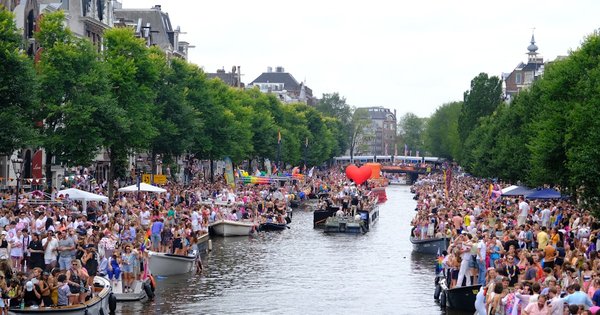
Amsterdam has hosted a Pride canal parade every year since 1996. In three decades of prime ministers, none of them had ever gotten on a boat. That changed on Saturday, when Rob Jetten climbed aboard a vessel at the Scheepvaartmuseum and sailed part of the route through the city center — the first sitting Dutch PM to join the parade in the 30 years it’s existed.
It’s a small logistical fact that carries a lot of weight, and not just because Jetten is himself openly gay. He’s been in office since February, when he was sworn in as the Netherlands’ first openly gay head of government — a milestone we covered at the time and one that, as we noted then, felt less like a rupture with the past than a fairly unremarkable next step for a country that legalized same-sex marriage a quarter-century ago. Saturday’s parade landed in the same spirit: notable mostly for how long it took to happen.
Threats, and showing up anyway
Jetten hasn’t been quiet about what the visibility costs him. Back in February, around the time he took office, he said publicly that he receives constant threats over his sexuality. That context mattered on Saturday. Amsterdam police installed roughly 250 concrete blocks along the parade route and the city put together a heightened security operation — not a routine precaution, but a direct response to the vehicle attack at Berlin’s Christopher Street Day parade in late July, where a car drove into the crowd, killed one person, and injured several others. The Dutch government has committed €35 million toward Pride-related safety measures and closer coordination with police this year, a number that reflects how much the security calculus around Pride events in Europe has shifted since Berlin.
Jetten sailing anyway, with that backdrop, is itself part of the message: the response to an attack on a Pride parade is more visibility, not less.
The policy that came with the photo op
What made Saturday more than a symbolic outing was what Jetten actually announced from the boat: his cabinet will move forward on the Regenboog Stembusakkoord — the Rainbow Ballot Agreement, a set of LGBTQI+ policy pledges that seven Dutch political parties signed onto ahead of the October 2025 elections. Two commitments stood out.
First, the government will expand the number of police discrimination detectives — officers specifically trained to investigate bias-motivated crimes — from four nationally to at least forty. That’s a tenfold increase, and it addresses a complaint LGBTQ+ advocacy groups in the Netherlands have raised for years: that hate crimes against queer people are reported but rarely result in a specialist actually working the case.
Second, the cabinet will revive a stalled bill that would ease the legal process for changing gender markers on official documents. Versions of this legislation have circulated in Dutch politics without making it across the finish line; putting it back on the agenda, with a prime minister’s public backing, gives it a better chance than it’s had in a while.
Neither commitment is dramatic on its own. Taken together with the fact that they were announced by a gay head of government on a Pride boat, in a year when European Pride events have become more dangerous rather than less, they read as follow-through rather than gesture.
Context: a country marking its own anniversary
The timing lines up with a bigger anniversary. The Netherlands became the first country in the world to open civil marriage to same-sex couples in 2001, and this year marks 25 years since that law took effect — one reason Amsterdam was chosen to host WorldPride 2026, which drew roughly a million visitors to the city this summer under the theme “Unity.” We wrote about that opening back in July, including the security posture the city adopted even before Berlin, and about what it meant for the Netherlands to host the world’s largest Pride gathering with an openly gay PM already in office.
Saturday’s parade was, in some sense, the quieter coda to that bigger event — 80 boats on the water, a head of government among them, and a couple of policy commitments that will matter more in a year than the parade itself will. That’s usually how it goes with this kind of incrementalism: the boat ride gets the headline, the discrimination detectives are the part that actually protects someone.