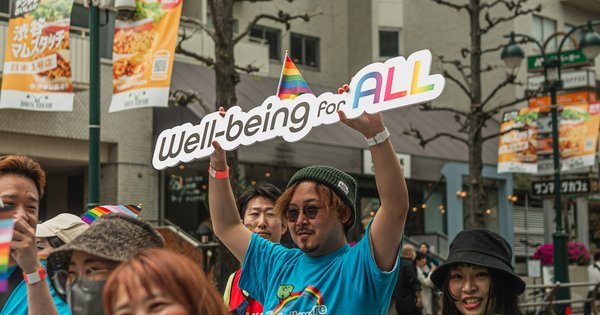
Japan is the only G7 country without nationwide legal recognition of same-sex couples. That sentence has been true for years, and it is still true today. But it has quietly become misleading — because while the national government and courts have stalled, Japan’s cities, wards and prefectures have built, piece by piece, a patchwork of recognition that now reaches more than 90% of the population.
It is one of the more remarkable workarounds in the global story of LGBTQ+ rights: a country that legally recognizes no same-sex couple at the national level, where the overwhelming majority of people nonetheless live somewhere that recognizes them locally. The mechanism is the partnership registry, and the way it spread says a lot about how change actually happens when the top of a government refuses to move.
How the patchwork was built
It started in 2015, when Tokyo’s Shibuya and Setagaya wards introduced the country’s first partnership certificate systems. They were modest instruments. A registry certificate is not marriage; it does not grant inheritance rights, spousal tax treatment, joint parental authority, or the immigration recognition that married couples receive. What it does is more local and more human: it lets a couple be treated as a family by their city. Hospital visitation. Public housing applications. A municipal acknowledgment that they exist as a unit.
From those two Tokyo wards, the idea spread the way good municipal ideas do in Japan — one local government watching its neighbor, then adopting the same thing. By 2025, Okinawa prefecture had enacted a registry. Nagasaki announced plans to introduce one in 2026. The running tally now stands at 32 of Japan’s 47 prefectures, plus more than 500 municipalities, together covering well over 90% of the population. A couple in most of urban Japan can get a certificate. The map has filled in almost entirely from the bottom up.
What it can and can’t do
It is important not to oversell this. A partnership registry is a recognition of dignity, not a grant of rights. The legal consequences that matter most in a crisis — who inherits, who can make medical decisions, who is the legal parent of a child, whether a foreign spouse can stay in the country — all still flow from marriage, and marriage in Japan remains, by the Civil Code’s own wording, between “both sexes.” Married binational couples elsewhere; same-sex partners in Japan don’t get that.
So the registries are best understood as something between a symbol and a tool. They have changed daily life for a lot of couples, and they have done something subtler too: they have made same-sex couples ordinary and visible to local bureaucracies across the country, which makes the eventual national argument harder to dismiss as abstract or foreign.
The courts are the other front
The legal fight is moving in parallel, and it is close. A wave of lawsuits filed across Japan has produced a striking run of district and high court rulings finding the marriage ban unconstitutional, or in a “state of unconstitutionality,” for violating equality guarantees. The Tokyo High Court was the outlier — in late 2025 it declined to find the ban unconstitutional, the only one of the six regional cases to break that way. Those cases are now headed toward the Supreme Court, which will ultimately decide whether the Constitution requires Japan to recognize same-sex marriage.
That sets up a genuinely consequential moment. Japanese courts cannot simply order parliament to write a law, but a Supreme Court ruling that the ban is unconstitutional would put enormous pressure on the Diet to act — and it would land in a country where 90% of people already live under some form of local recognition and where public opinion polls have shown majority support for marriage equality for years. The legal ground and the social ground have both shifted under a national law that hasn’t.
Why this belongs in the good-news column
We try to balance the hard stories with the hopeful ones, and Japan’s registry map is genuinely hopeful — not because the job is done, but because of how it got this far. There was no single dramatic victory, no charismatic court ruling that fixed everything. There was a slow, unglamorous accumulation of cities deciding to treat their queer residents as families, each one making the next one easier, until the holdouts became the conspicuous minority rather than the norm.
For the same-sex couples who built lives in the gap between local recognition and national rights, the certificate has never been enough — and they have said so, loudly, in the courts. But the patchwork they helped create is now one of the strongest arguments for finishing the job. When 90% of a country already lives as though same-sex couples are families, the question stops being whether to recognize them and becomes why the national law is the last thing left pretending otherwise.
Sources: Eco-Business — LGBTQ rights in 2026, Context by TRF, International IDEA — LGBTQIA+ rights in Asia and the Pacific.