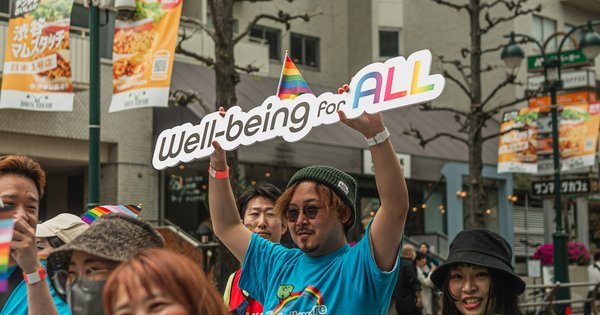
Most of the attention on LGBTQ+ Japan this year has gone, understandably, to the courts — to the string of high-court rulings that found the country’s same-sex marriage ban unconstitutional, and the Supreme Court showdown still to come. But away from the headlines, the Japanese government did something in June that may reshape queer life just as profoundly, and far more quietly: it approved the country’s first national plan to teach the public about sexual orientation and gender identity.
What the cabinet actually approved
On 16 June 2026, Japan’s cabinet adopted a “basic plan” to raise public understanding of LGBTQ+ people and other sexual minorities. It is grounded in the 2023 Act on Promotion of Understanding of Diversity of Sexual Orientation and Gender Identity — the so-called “LGBT understanding promotion law” — which set out a goal of tolerance but left the how largely undefined. The new plan is the how. For the first time, it connects schools, universities, workplaces, and local governments under a single framework, with concrete guidelines for each.
In schools, the plan encourages more support for LGBTQ+ students and broader access to counsellors and social workers, and it asks universities that train future teachers and healthcare workers to strengthen how they teach about gender and sexuality. In workplaces, it urges companies to adopt measures against discrimination and harassment in hiring and on the job, to run training, and to review internal rules so that LGBTQ+ employees can work with their dignity intact. The government has also committed to producing brochures and training videos on gender and sexual diversity and distributing them to institutions across the country.
Why a plan — and not a right — still matters
It is fair to be skeptical. This is an awareness-and-education framework, not an anti-discrimination law with teeth. It “encourages” and “urges” rather than compels, and Japan’s 2023 understanding-promotion law was itself criticized by activists for being watered down — its final text notably added language about the need to consider “all citizens,” which some feared could be turned against trans people rather than protecting them. A basic plan built on that foundation inherits its caution.
And yet the significance is real. Japan has never before attempted a systematic, nationwide push that reaches a queer teenager in a rural classroom, a trans job applicant, and an HR department in the same coordinated effort. Cultural change in Japan has tended to run ahead of legal change — local partnership registries now cover the vast majority of the population despite the absence of national marriage equality — and this plan is a bet on exactly that dynamic. Change the level of everyday understanding, the theory goes, and the law eventually has nowhere left to hide.
The two-track country
What makes Japan fascinating right now is that it is fighting for LGBTQ+ inclusion on two tracks at once, and the tracks are moving at different speeds. The judicial track is dramatic and slow: five high courts have said the marriage ban is unconstitutional, one has disagreed, and the Supreme Court will eventually have to choose. The administrative track — this new plan, the partnership registries, the workplace guidance — is undramatic and steady, accumulating in the background without a single climactic vote.
For queer people living in Japan, the second track may be the one they feel first. A Supreme Court ruling, whenever it comes, will be historic. But a school counsellor trained to support a gay student, or a company rulebook rewritten so a trans employee can transition without losing their job, changes a life this year, not after the next round of appeals.
Where this sits in the region
Across Asia, the pattern has increasingly been that courts, not legislatures, deliver the breakthroughs — Taiwan, Nepal, and now the pressure building in Japan. What is notable about the June plan is that it is the legislature-and-cabinet side of Japan finally moving, however cautiously, rather than waiting to be ordered by judges. It suggests a government that can read where its own public is heading.
We spend most of our time covering Europe, where these battles are often loud and adversarial. Japan is a reminder that inclusion can also advance in a lower key — through a cabinet document, a set of guidelines, a stack of training brochures — and still amount to something that matters. The marriage ruling will make the news. This plan may quietly do more of the work.