Ghana’s anti-LGBTQ+ bill just took a step backwards so it can take a step forwards.
On Tuesday, November 10, Ghana’s Parliament voted to cancel its own May vote passing the Human Sexual Rights and Family Values Bill, the law that would massively widen criminal penalties for LGBTQ+ people and their allies. That sounds like good news. It mostly isn’t. MPs did it so they can fix errors in the bill’s penalties, and the man running the government’s business in Parliament says the corrected version will be on President John Dramani Mahama’s desk before the end of November.
The short version
- What happened: Parliament rescinded its May 29, 2026 third-reading vote on the bill, by voice vote, Citi Newsroom reported.
- Why: Parliament’s drafters found that the final text didn’t match what MPs had actually decided on the floor, and they aren’t allowed to fix that themselves.
- What’s next: A “second consideration” to amend the problem clauses, a fresh third reading, then the bill goes to Mahama.
- Is it law? No. Not yet.
What went wrong
Speaker Alban Bagbin explained the problem in plain terms. The Legislation Drafting Department compiles the final text, but it can’t change what the House has decided. “They are the drafters who draft all what we do here, the decisions we take,” he said, according to Citi Newsroom. “But once there are decisions, they cannot tamper with the decision of the House.”
The motion to rescind was moved by Majority Leader James Agalga, 3News reported. His explanation: the sentencing maths was off. “How to compute penalty units was completely done in error, in some cases,” he said, adding that the penalties were “not aligned properly” with existing laws and that uncorrected, the bill “would have serious challenges when it comes to implementation.”
Read that again, because it’s the part that matters. The fix is about making the punishments work in court, not about softening them. Agalga said “not much of substance would change.”
The timeline from here
Rescinding the vote sends the bill back to the stage just before its third reading. Under Parliament’s rules, MPs can then move to delete, amend or add provisions, before reading it a third time again. Only then can the Clerk send it to the President.
Agalga has been clear about the target. Asked by GBC in early November whether the bill would reach the President before Parliament rises, he answered: “Absolutely,” GBC Ghana reported. At the time of writing, no date for the new third reading had been reported.
Once Mahama receives it, Article 106 of the Constitution gives him seven days to tell the Speaker whether he assents or refuses, unless he refers the bill to the Council of State, according to 3News.
Where Mahama stands
This is the big unknown, and it’s worth being precise about what he has actually said.
Speaking at Chatham House in London on June 1, Mahama said the Attorney-General and the Presidency’s legal team would review the bill before advising him on assent, and that if “substantial issues” were raised he would “return the bill to Parliament indicating exactly what the issues are,” 3News reported. Back in December 2024, as President-elect, he had urged his predecessor Nana Akufo-Addo to sign the earlier version before it expired.
Agalga pushed back on talk that the President had cooled on the bill: “Contrary to all the wild speculations that the President has shifted goalposts and all that. No, he hasn’t.” Minority Leader Alexander Afenyo-Markin, meanwhile, wants the bill signed unamended and opposes exemptions for some professionals that were added in May, according to 3News.
What the bill would do
Ghana already criminalises sex between men. Section 104 of the 1960 Criminal Code punishes “unnatural carnal knowledge” between consenting adults as a misdemeanour carrying up to three years in prison, and Ghana’s Supreme Court upheld it in July 2024, according to the Human Dignity Trust.
The new bill goes much further. According to Gayety’s summary of the May text, it keeps up to three years for same-sex sexual acts, adds three to five years for the “funding, sponsorship or promotion” of LGBTQ+ acts, creates a duty to report with up to three years for failing to do so, and makes offences extraditable. The corrections now under way concern how those penalties are calculated.
This is the bill’s second run. A version passed in February 2024 but former President Akufo-Addo withheld assent while legal challenges played out, and it lapsed when that Parliament ended. The revived version passed in May 2026, GBC noted. We covered the stalled push to make it even harsher in August, and the collapse of a “Visit Ghana” football sponsorship it overshadowed in September.
Why this moment matters
For queer Ghanaians, the last two years have been a long wait in a holding pattern: a bill passed, a bill lapsed, a bill revived, a bill passed again, and now a bill rewound. Every round of debate has brought a new wave of hostility online and offline.
What’s different now is the clock. If Agalga is right, the decision moves from Parliament to one person within weeks, and that person has seven days to make it. Ghanaian LGBTQ+ people and the groups that support them, many working quietly and at real personal risk, will be watching that desk. So will we.
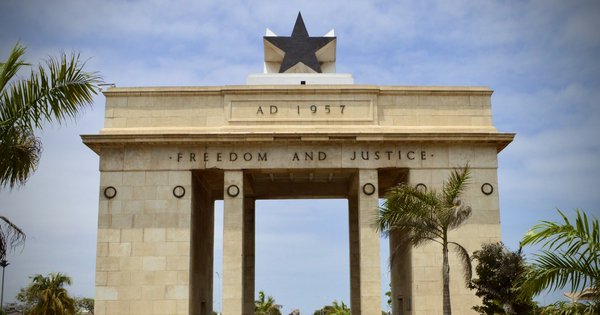
Photo: Independence Arch, Accra, by Ifeoluwa B. on Unsplash.