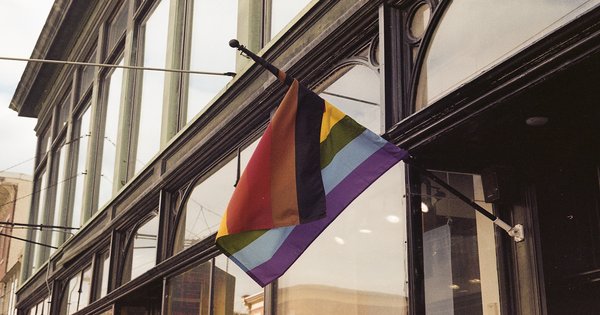
On Friday, staff at the central library in Mönchengladbach discovered that both rainbow flags flying outside the building were gone. The flags had gone up in June for Pride Month, part of a routine municipal gesture of visibility that libraries and city halls across Germany repeat every summer. The library’s response was almost as routine at this point: replace the flags, add rainbow garlands to the entrance, and move on. It is not the first time flags have disappeared from outside a German public library this year, and it will not be the last.
None of this made international news, and on its own it probably shouldn’t. But set alongside the rest of the summer, the pattern is hard to ignore. On August 8, a man tore down two rainbow flags affixed to the front window of Tipsy Bear, a queer bar in Berlin’s Prenzlauer Berg neighborhood, and fled toward the Eberswalder Straße subway station. A week earlier, a rainbow flag outside a church hosting a Pride-adjacent event was vandalized during the event itself. In Rhineland-Palatinate, the regional reporting desk that tracks anti-queer incidents has logged a rise in exactly this category of harassment — vandalism, insults, strangers shouting at people on the street — even as the region’s more organized hate-crime statistics remain a separate, slower-moving count.
A different register of harm
It is worth being precise about what this is and isn’t. Germany’s most serious LGBTQ+ story of the year remains the fatal car-ramming attack on a Berlin Pride celebration in July, an act of organized far-right violence that prompted national mourning and a security response across the country’s Pride season — Hamburg and other cities visibly tightened protocols in its wake. That attack sits in a different category of harm than a stolen flag, and it would be wrong to flatten the two together.
But the smaller incidents matter precisely because they are not isolated to a single perpetrator or a single night. They are diffuse, low-cost, low-risk acts that anyone can commit and almost no one gets caught for — the flag thief in Mönchengladbach remains unidentified, as does the man in Prenzlauer Berg. Advocacy groups that track this category describe it as a permission structure: each unpunished incident signals that the act carries no real consequence, which makes the next one slightly more likely. The Center for Monitoring, Analysis and Strategy has counted 17 explicitly anti-Pride demonstrations organized by the far right in Germany so far in 2026, a separate but related data point showing organized opposition has grown alongside the more spontaneous vandalism.
What it does to daily life
The practical effect described by queer organizers in affected regions is quieter than any single incident: groups have started declining to publicize meeting locations in advance, and some community events have scaled back public signage rather than replace flags a third or fourth time. That is a meaningful behavioral shift — not driven by any one attack, but by the cumulative sense that visibility now carries a small, recurring cost. None of this rises to the scale of the Berlin attack, and German officials have not treated the flag incidents as a coordinated campaign. But the accumulation is its own kind of signal, and it is the one most LGBTQ+ Germans are more likely to encounter directly than a headline-grabbing act of mass violence.
The response so far
Municipalities have mostly answered in kind — replace the flag, add a statement about tolerance, move on — which is a reasonable response to a single theft but does little to address a pattern. A handful of cities, including Mönchengladbach, have discussed switching to more theft-resistant flag mounts or filing formal police reports for each incident to build a documented trend line that could eventually support hate-crime charges rather than simple property-theft cases, which typically go nowhere. Whether that documentation effort produces any actual prosecutions is the thing worth watching next: right now, nearly every one of this summer’s small incidents remains open, unresolved, and quietly added to next year’s tally.