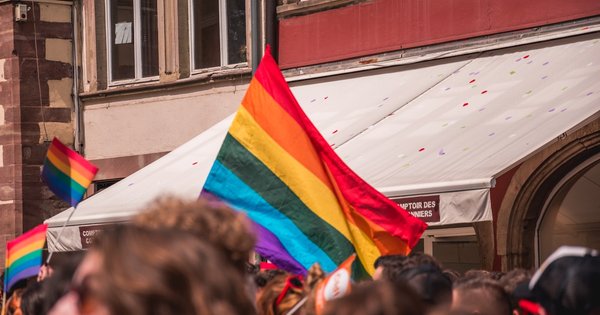
France tends to get filed in people’s minds as one of Europe’s LGBTQ+ success stories — and on paper, there is a case for that. Marriage equality has been law since 2013. France was an early mover on banning conversion practices, prohibiting them in 2022. Same-sex couples have full joint adoption rights, a status shared by only a handful of European countries. By the headline metrics, France belongs in the same conversation as the Netherlands, Belgium, and Spain.
But “by the headline metrics” is doing a lot of work in that sentence. Look past marriage equality and the 2026 picture gets more complicated, and a lot less reassuring.
The numbers that complicate the story
The clearest warning sign is hate crime. There were roughly 4,800 anti-LGBTQ+ offences reported in France in 2024, up 5 percent from the year before. That single-year jump sits on top of a longer trend: between 2016 and 2023, reported anti-LGBTQ+ offences rose at an average of around 15 percent per year. The advocacy group SOS homophobie, in its most recent annual report, tied the climb directly to the rise of reactionary and far-right politics in the country.
Reported offences are an imperfect measure — some of the increase reflects more people coming forward, which is in itself a sign of trust in reporting systems. But a sustained, years-long rise of that magnitude is not just a reporting artifact. It describes a country where being visibly queer has, by the community’s own account, become riskier over the past decade, even as the legal architecture of equality stayed in place.
Trans rights are where the gap is widest
If marriage equality is where France looks strong, gender recognition is where it looks distinctly average for Western Europe. Changing one’s gender marker and first name on official documents still generally requires going through a court — a slower, more burdensome process than the self-determination models now in place in countries like Spain, Ireland, and Belgium. For many trans people in France, that court requirement is one of the most concrete day-to-day barriers they face, and it is one of the reforms the community has campaigned on most consistently.
France also flirted with moving in the wrong direction. A bill to ban medical transition for people under 18 cleared the Senate in 2024 and brought large protests into the streets. It has not become law — it faces opposition in the National Assembly and from the government — but its mere advancement signaled that trans healthcare is now contested terrain in France in a way it had not visibly been before. That is the same anti-trans political energy reshaping debates in the UK, Italy, and parts of Eastern Europe, and France is not immune to it.
Why the gap between law and life matters
The useful lesson here is not “France is secretly bad.” It plainly is not — full marriage equality, adoption rights, and a conversion-practices ban are real protections that millions of people in less fortunate countries would want. The lesson is that legal milestones and lived safety are two different measurements, and they can move in opposite directions at the same time.
This is exactly the trap of treating a country’s “best country for LGBTQ+ rights” ranking as the whole story. When ILGA-Europe’s Rainbow Map named Spain the top-ranked country in Europe this spring, the same organizations noted that Spain has also seen a hate-crime surge. The two facts coexist. Strong law does not automatically buy safety on the street, and a rising far right can erode lived experience well before it manages to change a single statute.
For LGBTQ+ travelers and people thinking about where to live in Europe — something we field questions about constantly — France is a reminder to read past the legal scorecard. The protections are genuine and worth having. But the trend lines on hate crime and the friction around trans recognition are part of the same country, and they deserve the same attention as the marriage-equality headline that usually defines it.