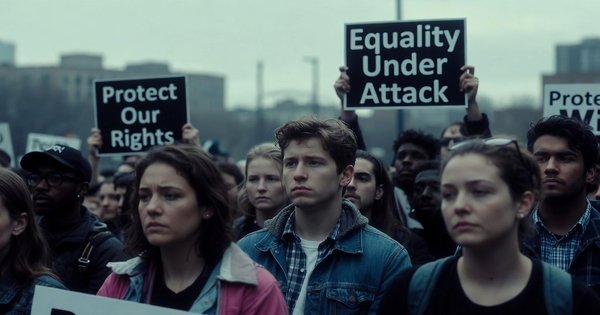
On June 1 — the first day of Pride Month — a federal appeals court ruled that the Trump administration’s policy banning transgender people from military service is likely unconstitutional, and used unusually direct language to say why. A three-judge panel of the U.S. Court of Appeals for the D.C. Circuit split 2-1 in Talbott v. United States, finding that the ban rolled out by Defense Secretary Pete Hegseth was driven by animus toward transgender people rather than any legitimate military rationale.
Writing for the majority, Judge Robert Wilkins held that the policy “appears to be driven by the bare desire to harm a politically unpopular group: persons who identify as transgender.” That phrasing is not casual. “A bare desire to harm a politically unpopular group” is a specific legal formulation, drawn from a line of Supreme Court cases, that signals a law cannot survive even the most deferential constitutional review. Judges Wilkins and Judith Rogers concluded the policy likely violates the Constitution’s guarantee of equal protection.
What the ruling does — and does not — do
The decision is a split outcome, and the distinction matters. The panel concluded that the administration may continue to bar transgender recruits from joining the military, but it may not immediately remove transgender troops who are already actively serving. In practical terms, the ruling blocks the Defense Department from separating the current service members who brought the lawsuit on the basis of gender dysphoria.
That is a meaningful but partial victory. The plaintiffs — active-duty transgender service members, several of them long-serving and decorated — are protected from removal for now. But the broader ban remains in effect while litigation continues, and the door to new transgender enlistment stays closed. This is an appellate ruling on the likelihood of success, not a final judgment, and the administration is expected to seek further review, potentially at the Supreme Court.
The dissent
The panel’s lone dissent came from Judge Justin Walker, a Trump appointee, who argued that the courts are the wrong branch to be making this call. “We have neither the expertise nor the authority to decide whether the military can exclude the plaintiffs from its ranks,” Walker wrote. “The Constitution assigns that authority to Congress and the Commander in Chief.” The disagreement on the panel mirrors the larger legal fight: not only whether the ban is motivated by animus, but how much deference courts owe the executive on questions of military personnel.
Where this fits in a larger campaign
The transgender military ban is one piece of a much wider rollback. Since returning to office, the administration has moved against transgender rights on multiple fronts at once — restricting accurate gender markers on passports, removing gender-affirming care from the list of essential health benefits most insurance plans must cover, and signing executive orders targeting transgender athletes and broader diversity programs. The Supreme Court has, in several instances, allowed contested policies to remain in force while challenges proceed.
Against that pattern, the D.C. Circuit’s language stands out. Courts reviewing this administration’s LGBTQ+ policies have often ruled on narrow procedural grounds; a finding that a policy is rooted in “a bare desire to harm” goes to motive, and it is the kind of conclusion that is harder to walk back on appeal. It also lands at a symbolic moment — handed down on the opening day of Pride Month, about a population of service members who, by the military’s own prior assessments, had served without measurable harm to readiness.
What to watch next
Three things will determine where this goes. First, whether the full D.C. Circuit agrees to rehear the case en banc, which either side could request. Second, whether the administration takes it to the Supreme Court, and if so, whether the justices treat it like the other transgender-rights cases they have recently handled on the emergency docket. Third, what happens to the thousands of transgender troops not named in this particular suit — the ruling’s direct protection runs to the plaintiffs, and the scope of relief for everyone else remains contested.
For now, the headline is narrow but real: a federal appeals court has told the Pentagon, in plain terms, that it cannot remove the transgender service members who sued, and that the policy behind their attempted removal looks like it was built to harm them.
This piece covers a difficult ongoing rights rollback. If you are a service member affected by these policies, legal organisations including GLAD Law and the National Center for Lesbian Rights, which represent the Talbott plaintiffs, maintain public resources on the litigation.
Sources: CBS News, GLAD Law: Talbott v. USA, JURIST.