A rainbow flag that belonged to a Colombian activist. A 2006 lesbian campaign poster. An early issue of a gay magazine. A photo of a march for LGBT citizenship. Until last week, all of them hung in Colombia’s national museum in Bogotá. Now there are marks on the walls where they used to be.
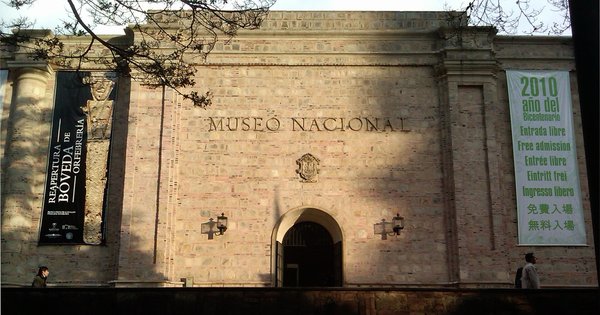
On October 15, Colombia’s culture ministry ordered more than 30 posters, photographs and objects removed from the permanent displays of the Museo Nacional de Colombia. Many told the story of LGBTIQ+ and feminist movements. Others remembered political violence and the 2016 peace agreement. Since then there have been two days of protests, a joint statement from six museums, and a court order. Here’s the story so far.
What was taken down
According to La Silla Vacía, which broke the story, at least ten LGBTI and feminist objects were removed from “Hacer sociedad” (Building society), a second-floor room that opened in 2019. They include:
- The Pride flag that belonged to activist Elizabeth Castillo
- A lesbian campaign piece from the 2006 LGBT march
- A print on women’s reproductive rights from Fundación Sí Mujer
- A photograph by Humberto Rincón Perfetti of the march for LGBT citizenship
- Issue no. 2 of La Ventana Gay, the magazine by Manuel Antonio Velandia and León Zuleta
Other removals hit Colombia’s political memory: campaign posters for presidential candidates Bernardo Jaramillo Ossa and Carlos Pizarro, both assassinated in 1990, and the “Balígrafo,” the pen made from a bullet that was used to sign the 2016 peace agreement with the FARC. Almost every photo on a wall about the 1950s to the 1970s in the “Memoria y Nación” room came down too.
Anonymous museum staff told La Silla Vacía that the ministry’s secretary general, Julián Sterling, picked the pieces himself, behind closed doors, and that decisions like this are supposed to go through the museum’s curatorial committees. The museum has had no permanent director since Liliana Angulo Cortés died in February, The Art Newspaper notes.
What the government says
Culture Minister Paola Holguín defended the removals on X. The museum, she wrote, cannot be “un espacio de apología al delito o revictimización” (a space that glorifies crime or re-victimises people), nor an “instrumento de adoctrinamiento político” (an instrument of political indoctrination), El Colombiano reports. She also said the museum had to protect children from “material sensible,” without saying which pieces she meant.
The removals fit a bigger plan. President Abelardo de la Espriella, in office since August 7, has announced a “contrarrevolución cultural” and an open fight against “wokismo.” He also wants to rename the culture ministry the Ministry of Culture and Heritage, calling the word “patrimonio” “a direct blow to ‘wokeism’,” per The Art Newspaper.
It’s the latest in a run of moves that worry Colombia’s LGBTIQ+ community. In September, the government pulled Colombia out of the Equal Rights Coalition it had been co-chairing, weeks after a report counted 270 LGBTIQ+ people murdered in 2025.
The pushback
The reaction was fast.
- On the street: Hundreds gathered outside the museum on Carrera Séptima on Saturday, October 17, and Sunday, October 18. They pasted copies of the removed works onto an outdoor installation and held signs reading “La memoria no se borra” (Memory can’t be erased). Riot police broke up the crowds with tear gas, stun grenades and water cannons on both days, The Art Newspaper reports.
- From other museums: Six Colombian museums, including the Museo de Arte Moderno de Bogotá and the Museo de Arte Moderno de Medellín, issued a joint statement of “deep concern.” It asks for a public review and says: “No government should decide which parts of our history we can see based on its political preferences.”
- From the community: LGBTIQ+ rights group Colombia Diversa raised concern about the removals, and activist David Pérez called the decision “un acto profundamente violento” (a deeply violent act), El Colombiano reports. Former presidential candidate Juan Daniel Oviedo put it simply: “La historia de las personas #LGBTIQ+ es historia de #Colombia.” (The history of LGBTIQ+ people is Colombia’s history.)
A judge steps in
On Monday, October 19, Bogotá judge César Osorio Ortiz issued a temporary order. The museum must preserve the removed works, stop further removals based on content without formal justification, and the ministry has to explain the legal basis for what it did, according to The Art Newspaper.
That’s not a win yet. The court hasn’t ruled on the case itself, and the pieces are still off display. But it means the flag, the posters and the magazine can’t quietly disappear while the case runs.
Why a flag in a museum matters
Laws can be repealed and restored. Memory is harder to rebuild once it’s gone. Colombia still has marriage equality and hate-crime protections on the books. But who gets to appear in the national story shapes how a country sees its own people.
The “Hacer sociedad” room was put together with a curatorial script of more than 200 pages and four curatorial committees, reviewed in 2019 under former president Iván Duque, El Colombiano notes. Queer Colombians made it onto the walls of their national museum through years of organising. The weekend crowds on Carrera Séptima made clear they don’t plan to be taken back off quietly.
Sources: La Silla Vacía; The Art Newspaper; El Colombiano.
Photo: Peter Angritt / Wikimedia Commons, CC BY-SA 3.0 (2011).