Update (September 28, 2026): On September 25, the city government and the Comisión Organizadora announced an agreement: the 35th Marcha del Orgullo will go ahead on its original date, Saturday, November 7, on its traditional route through the city centre, with the city coordinating it with the security operation for Pope Leo XIV’s arrival the next day (elDiarioAR, Perfil, Ámbito).
For almost three decades, Buenos Aires has held its Pride march on the first Saturday of November. This year that falls on November 7, the day before Pope Leo XIV lands in Argentina. The city government now wants the march moved, and the people who organise it have said no.
What the city decided
On Friday, September 18, the city government of Buenos Aires published a resolution in its Official Gazette. It says no “events, entertainment or acts in public space” will be authorised from November 6 through November 13, except those linked to the Pope’s official schedule. According to elDiarioAR, the measure was signed on September 17 by the city departments responsible for urban maintenance, transport and security.
Leo XIV is due in Argentina from November 8 to 11. In its statement, reported by the Spanish news agency EFE, the city described the restriction as exceptional. It said the visit would require a major operational, logistical and security deployment. According to elDiarioAR, the resolution anticipates extra police, firefighters and traffic staff, along with street closures and diversions. The ban starts two days before the Pope arrives and lasts two days after he leaves.
That window takes in November 7, the date set months ago for the 35th Marcha del Orgullo. The city had already asked the organising commission to move the march to November 21. In its statement, the city said the goal was to make sure the march could still happen, with the city providing the resources for a safe, orderly and celebratory day, as it has in the past. City sources quoted in Argentine media said the change also affects other mass events planned for that weekend and has nothing to do with what the march stands for.
Why organisers won’t budge
The Comisión Organizadora de la Marcha del Orgullo replied with an open letter to the city’s head of government, Jorge Macri, and confirmed the original date.
They made several points. The Pope doesn’t arrive until the day after the march. His biggest public event in the city is planned for two days later and in a different part of Buenos Aires. According to the commission, neither Argentina’s national government nor the Vatican had asked them to change the date. The request came only from the city.
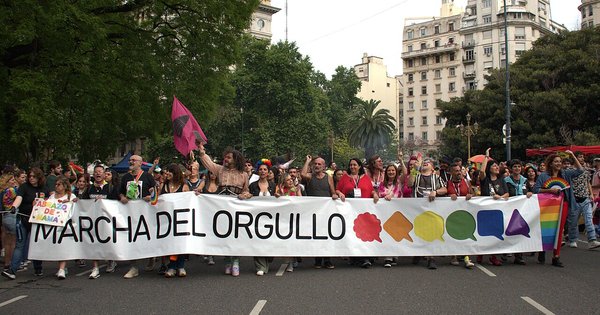
They also argued that a march this size can’t simply be moved. Organisers say recent editions have drawn around two million people. Delegations from the provinces and abroad have already bought tickets and booked accommodation, and artists, unions, student groups and human rights organisations have kept the date free for months. Pride marches in other Argentine cities also set their dates around the Buenos Aires one, so a change here would affect the whole country’s calendar.
“Changing its date doesn’t mean moving an activity in a calendar,” the commission wrote, according to EFE. It said a new date would upend a nationwide operation that took months to build and decisions already made by thousands of people.
The commission also cited city Law 6482. By its reading, that law recognises that LGBT+ organisations themselves set the date of the march. It questioned whether the city could make its logistical support conditional on a new date. The commission said it understands the institutional importance of a visit by a head of state and leader of the Catholic Church, and the difficulty of the security operation. It just doesn’t accept that the visit justifies shifting the march.
A date with history
The date isn’t arbitrary. As EFE notes, Argentina has held its Pride on the first Saturday of November since 1997, not in June. The date commemorates the founding of Nuestro Mundo in November 1967, the country’s first homosexual rights group and one of the earliest in Latin America. Buenos Aires held its first Pride march in 1992, with about 250 people, many of them masked. That’s why this year’s is the 35th.
The march also matters more to Argentina’s queer community than it did a few years ago. Argentina was the first country in Latin America to legalise same-sex marriage, in 2010. Its 2012 Gender Identity Law is still one of the most progressive in the world. But the national political climate has turned colder under President Javier Milei. In January 2025 he told the World Economic Forum in Davos that, in its most extreme forms, “gender ideology” amounts to child abuse. Days later, on February 1, LGBTQ+ groups, unions and other movements answered with a nationwide anti-fascist and anti-racist march that brought huge crowds onto the streets. For many people, the November march has become a show of strength as well as a celebration.
What happens next
As of this weekend, the two sides are at a standoff. The city’s resolution stands, and the commission is still calling people onto the streets on November 7. With about seven weeks to go, the likeliest outcomes are a negotiated compromise on the route or logistics, or a march that goes ahead without official approval. That would test how far a city government will go to enforce an events ban against one of the largest Pride marches in the world.
Whichever it is, it’s worth watching. Argentina has long been a model for LGBTQ+ legal progress in Latin America. How Buenos Aires handles this dispute will show whether that record still counts for much when it runs into a bigger political priority.
Sources: EFE via Infobae, “Visita del papa a Argentina abre disputa al coincidir con la Marcha del Orgullo LGBTI” (Sept. 18, 2026); elDiarioAR, “La Ciudad no autorizará la Marcha del Orgullo por la visita del Papa” (Sept. 18, 2026); Página/12 (Sept. 18, 2026).