Correction (September 28, 2026): This article originally said transgender people in Serbia have no path to update their documents except a patchwork of inconsistent administrative practices. In fact, since 2019 they can change their legal gender marker without surgery, through a set medical procedure requiring sign-off from a psychiatrist and an endocrinologist after a year of hormone therapy; there is still no gender identity law.
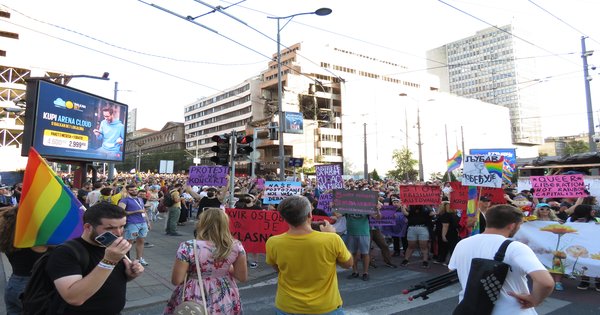
Belgrade Pride Week wrapped up on September 6, capping a milestone year: 25 years since Serbia’s first, brutally disrupted Pride march. This year’s edition, held under the theme “There is a room for all of us,” passed largely without the violence that has marked past editions — a genuine marker of progress in a country where the earliest marches were met with riots. But now that the marches, panels, and parties are behind them, Serbian LGBTI+ organizations are using the moment to make an uncomfortable point: a quarter-century of visibility hasn’t produced a single law protecting same-sex couples or transgender people.
The demand hasn’t changed in years
In the days since the September 5 march, activist groups and allied organizations have renewed calls for two specific pieces of legislation Serbia still lacks: a law recognizing same-sex partnerships, and a law establishing legal gender identity recognition. Neither exists in any form. Serbia has no domestic partnership registry and no civil union framework, and transgender citizens can update their legal documents only through a medical route: since 2019 no surgery is required, but a psychiatrist and an endocrinologist must sign off after a year of hormone therapy.
That’s not for lack of asking. Serbian LGBTI+ groups have pressed the same two demands at every Belgrade Pride for the better part of a decade, through multiple governments and shifting political crises. What’s notable this year is the tone: less celebratory insistence that change is coming, more blunt frustration that it hasn’t.
A Pride shaped by national unrest
This year’s march also unfolded against the backdrop of Serbia’s prolonged student-led protest movement, which has convulsed the country’s politics since late 2024 over corruption and government accountability. Belgrade Pride organizers have increasingly framed LGBTI+ rights as one thread in a broader argument about how the Serbian state treats its citizens — pointing to police conduct toward protesters generally as evidence that institutional reform, not just anti-discrimination messaging, is what’s actually needed.
The march itself moved from Manjež Park toward the National Assembly and back, largely without serious incident. Counter-protesters gathered near a church along the route, playing religious music and, in a handful of ugly moments, invoking the name of a convicted war criminal. Police intervened to keep the march moving and removed at least one disruptive figure near the National Assembly building. Compared to the earliest Belgrade Prides — the 2001 march was violently attacked within minutes, and the event was banned outright for years afterward — this was a quiet day. Organizers and international observers, including a statement of support from the UN in Serbia, treated that as its own kind of milestone.
Why the law still hasn’t moved
Serbia has flirted with partnership legislation before. A draft law on same-sex civil unions was floated years ago and quietly shelved amid political backlash, and no government since has made a serious legislative push. Serbia’s EU accession process — the country has been a candidate since 2012, with talks moving slowly — theoretically creates pressure to align with European norms on anti-discrimination and family law, but Brussels has limited leverage as long as Belgrade’s broader accession timeline remains stalled over other issues, including the country’s relationship with Kosovo and rule-of-law benchmarks.
In practice, that leaves LGBTI+ Serbians in a familiar bind common across the Western Balkans: formal decriminalization and a public Pride march coexist with the absence of any legal recognition for their relationships or identities. Serbia can point to a visible, tolerated Pride as evidence of progress while pointing to EU accession gridlock as an excuse for legislative inaction — and LGBTI+ organizations are left making the same argument every September.
What comes next
There’s no legislative timeline attached to this year’s renewed push. Activists are calling on the government to at minimum restart public consultation on a partnership law, something that hasn’t meaningfully happened in years. Whether that translates into an actual bill remains, as it has for a decade, an open question.
What’s changed is the framing. Twenty-five years ago, simply holding a Pride march in Belgrade without it being violently shut down was the goal. That’s been achieved, more or less, for several years running. The unresolved question now is whether a safer march is worth much if it isn’t backed by anything in the law — a gap Serbian activists intend to keep naming until it closes.