Austria's Far Right Takes Aim at Rainbow Crosswalks, and at a Queer Centre's Security Glass
In the same week, the FPÖ asked Austria's parliament to ban rainbow pedestrian crossings and mocked Vienna's queer history centre Qwien for installing armoured glass near a far-right venue. Every other party pushed back.
Two debates in Austria this week, one in the national parliament and one in Vienna’s city council, were officially about traffic regulations and construction budgets. In practice, both were about how visible queer people are allowed to be, and how safe they are allowed to feel while being visible.
In both rooms, the far-right Freedom Party (FPÖ) made its case. In both, it lost.
A traffic law aimed at rainbows
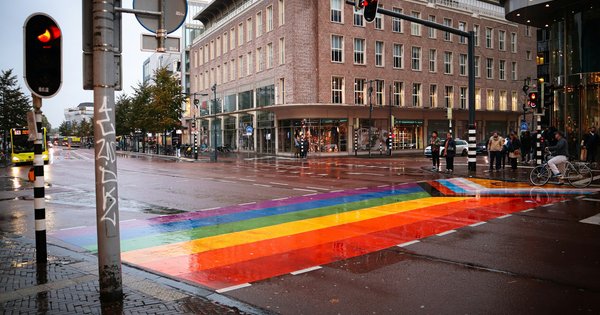
On Wednesday, September 23, Austria’s National Council debated a motion from FPÖ MP Maximilian Weinzierl to amend the country’s road traffic regulations so that pedestrian crossings could only be marked in the road’s colour or a single tone. Multicoloured designs, patterns, images, text and symbols would all be banned, Kosmo reported. The motion was first submitted in July.
Nobody was confused about which multicoloured design the party had in mind. Queer.de called it a “culture war over asphalt.”
The FPÖ’s stated argument is safety. Existing rules already require crosswalk stripes to be white and 50 centimetres wide, with enough contrast to be seen, and the motion argues that a crossing is “not a design element and not a message carrier,” according to Kosmo. The party points to a local traffic authority in Scheibbs, Lower Austria, that turned down a multicoloured crossing over contrast concerns, and says it wants one national rule instead of case-by-case decisions. Weinzierl framed it bluntly, telling eXXpress that road traffic is “no test laboratory for woke experiments” (quotes here are translated from German).
Every other party in parliament rejected the idea, according to Queer.de:
- ÖVP MP Joachim Schnabel, from the conservative party of Chancellor Christian Stocker, which has governed in a coalition with the SPÖ and NEOS since March 2025, called the safety argument a pretext and said the truly dangerous colour was brown, a pointed reference to the FPÖ’s far-right associations.
- SPÖ MP Wolfgang Moitzi accused the FPÖ of only discovering an interest in road safety when queer visibility is involved.
- NEOS MP Dominik Oberhofer pointed to the many cities around the world that have rainbow crossings without problems.
- Greens MP David Stögmüller said simply that rainbow crosswalks harm no one.
Queer.de also pointed to research that cuts against the FPÖ’s premise: a 2022 “Asphalt Art Safety Study” of 22 street sites in the US found that crashes involving pedestrians or cyclists fell by 50 percent after colourful redesigns, as drivers slowed down around them.
With all four other parliamentary groups opposed, the motion has no visible path to a majority. But the FPÖ is not a fringe party. It finished first in the 2024 national election with 28.85 percent of the vote and 57 of 183 seats, and went into opposition only after party leader Herbert Kickl failed to form a coalition in February 2025, as Wikipedia’s summary records. Queer.de notes that an FPÖ politician, Michael Gruber, called last year for Pride (CSD) demonstrations to be banned.
Bulletproof glass on the next block
The same day, Vienna’s city council voted on money for Qwien, the city’s centre for queer history and culture, which Queer.de describes as Austria’s largest queer centre.
The council approved raising Qwien’s construction subsidy from €360,000 to €438,000, an increase of €78,000, with the Social Democrats (SPÖ), NEOS and the Greens voting in favour and the ÖVP and FPÖ against, GGG.at reported. Part of the increase covers security, and the reason is on Qwien’s own street: the far-right Identitarian movement operates a venue just a few buildings away.
The city’s official record of the session shows how the parties framed it. Green councillor Jennifer Kickert said the higher subsidy was due to necessary security renovations following hate crimes against Qwien. SPÖ councillor Patricia Anderle pointed to the nearby Identitarian venue as a source of fear of intimidation and violence. FPÖ councillor Armin Blind acknowledged that authorities had required unforeseen structural changes, such as escape routes and accessibility work, but questioned whether the city had verified any threat to the site. ÖVP councillor Gorlitzer called the funding disproportionate compared with district museums.
According to GGG.at, the work includes reinforced entrance doors, expanded surveillance, barrier-free access and improved emergency exits, and one of the measures was bulletproof glass. Qwien’s Andreas Brunner told Queer.de, as quoted by GGG.at, that the FPÖ had “mocked us in council for installing armoured glass,” and that the threat looks very different to the people it is aimed at than it does to the FPÖ.
GGG.at notes that there are documented links between the Identitarians and the FPÖ, while being careful to say this does not make the party directly responsible for any threat against Qwien. Earlier this month, the site also pushed back on tabloid coverage after the Kronen Zeitung described the Qwien funding as a “rain of money,” pointing out that the paper itself received €7.3 million in media subsidies and €17.3 million in public-sector advertising in 2024.
Why a crosswalk and a door matter
It would be easy to treat both stories as small. A painted crossing is paint. A security upgrade is a line item.
But taken together, they show a pattern queer Europeans will recognise from Hungary to Germany: an opposition party with real electoral weight testing whether public symbols of LGBTQ+ acceptance can be removed on technical grounds, while treating the security needs of queer spaces as a joke or a waste. Neither effort succeeded this week, and it matters that the ÖVP, which governs with the SPÖ and NEOS, stood with the centre-left rather than with the FPÖ on the crosswalk motion.
For queer people in Austria, and for the many LGBTQ+ visitors who pass through Vienna, this week’s votes were a reminder that visibility is never settled once and for all. It is something politicians have to keep choosing to defend. For now, most of Austria’s still are.