We’ve spent enough summers in Tirana now that the question we get most from friends back home — “Wait, is it safe to be gay in Albania?” — has an answer that’s more interesting than a yes or no. The honest version is: Albania is one of the more quietly encouraging stories in the Balkans, and a lot of that has to do with a carrot dangling just out of reach — European Union membership. From where we sit, mid-2026, the connection between Albania’s EU bid and its LGBTQ+ rights is impossible to miss.
The EU is doing a lot of the pushing
Albania is an EU candidate country. It opened accession talks in 2022, and Prime Minister Edi Rama has floated 2030 as a target for being ready to join — a timeline he himself has called “very ambitious.” Whatever you make of the date, the process has real gravitational pull. Brussels evaluates candidate countries on fundamental rights, and the treatment of LGBTQ+ people is one of the metrics that gets watched. That external scrutiny changes the domestic math: reforms that might otherwise stall become bargaining chips in a much larger negotiation about the country’s future.
You can see it in the paper trail. Albania has a National Action Plan for LGBTI+ persons running through 2027, and a UN review in mid-2025 noted “clear political will” behind it, with both national and municipal officials voicing commitment. In a region where governments often treat LGBTQ+ policy as a political liability, that’s not nothing.
The real progress
Albania decriminalized same-sex activity back in 1995, in the years after communism fell. Since then it has built out comprehensive anti-discrimination protections — on paper, some of the strongest in the Western Balkans. In late 2025, parliament passed a landmark Gender Equality Law that, in its adopted form, prohibits less favorable treatment based on sex, sexual orientation, gender identity, gender expression, and sex characteristics.
There’s also movement on conversion therapy. Albania has restricted the practice within the psychology profession — a partial ban that puts it ahead of most of its neighbors, even if it doesn’t yet reach every corner of the healthcare system.
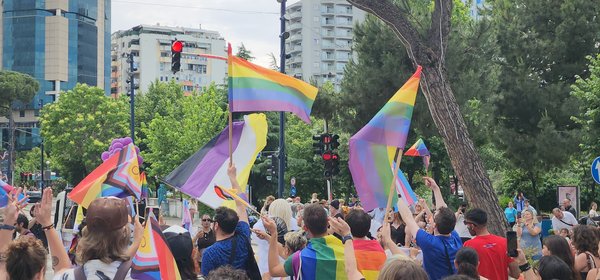
And then there’s Tirana Pride, which we’ve now watched grow in person. Each year the march draws not just the community but a striking amount of official and diplomatic support — EU representatives, foreign embassies, and Albanian officials showing up in a way that would have been unthinkable a decade ago. It’s a small country’s Pride, but it doesn’t feel embattled the way some in the region still do.
The missing pieces
We try to be honest about this rather than boosterish, because the gaps are real. Albania still has no legal recognition of same-sex partnerships — no marriage, no civil unions, nothing. Couples here have no legal framework for their relationships, full stop. There’s also no gender-recognition law, which leaves trans Albanians without a clear, accessible path to correct their documents — exactly the kind of procedure the EU’s top court flagged as a fundamental right earlier this year.
Even the wins came with fights. The 2025 Gender Equality Law was watered down before passage: the ruling Socialist Party stripped out terms like “diversity,” “intersectional discrimination,” and “gender stereotypes.” So the progress is genuine, but it arrives negotiated, hedged, and often quieter than the headlines suggest.
What it feels like on the ground
Day to day, Tirana reads as relaxed and modern in the ways that matter to us — the Blloku neighborhood is full of cafés and bars where nobody blinks, and we’ve never felt we had to perform straightness to move through the city. That’s not the same as full legal equality, and rural Albania is a different conversation than the capital. But the trajectory is up, and the EU process gives that trajectory something rare in the Balkans: a deadline, or at least the promise of one.
For anyone tracking LGBTQ+ rights in Southeast Europe, Albania is worth watching precisely because it’s a live test of a hopeful theory — that the pull of European integration can drag rights forward faster than domestic politics alone would allow. From our apartment in Tirana, it mostly looks like that theory is holding. Slowly, incompletely, but holding.
Sources: Tirana Times; TGEU; Balkan Insight.