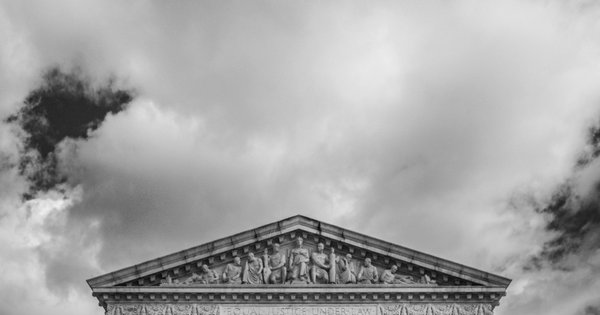
The Trump administration is once again asking the Supreme Court to let it push transgender troops out of the military — this time before their case has even gone to trial. On August 28, the Justice Department filed a 300-page petition asking the justices to lift a preliminary injunction that has, for now, protected 29 transgender plaintiffs in Talbott v. United States from discharge while the lawsuit against the Pentagon’s ban proceeds.
The petition argues that “the authority of the U.S. military to determine who may serve in the nation’s armed forces is a matter of exceptional importance,” and asks the Court to act now rather than wait for the case’s scheduled January 2027 trial. If the justices agree, discharges of the named plaintiffs — who include active-duty service members, reservists, National Guard members, and at least one person still trying to enlist — could begin almost immediately.
A second bite at the same policy
This is not the administration’s first trip to the Supreme Court over transgender troops. In May, the Court granted an earlier emergency request and lifted a broader nationwide injunction in a related case, Shilling v. Trump, allowing the Pentagon to begin separating roughly 1,000 service members identified for removal under Defense Secretary Pete Hegseth’s ban. That order came without a written opinion; the three liberal justices dissented.
Talbott, led by Army Reserve Second Lt. Nicolas Talbott, is a separate but closely related challenge, filed in January 2025 days after President Trump’s executive order barring transgender people from military service. In June, a divided D.C. Circuit panel handed the plaintiffs a partial win, ruling 2-1 that the ban “appears to be driven by the bare desire to harm a politically unpopular group” — language pulled directly from Supreme Court precedent on unconstitutional discrimination. That ruling let the administration keep barring new transgender recruits, but blocked it from removing the Talbott plaintiffs already in uniform while the case continued.
The new petition asks the Supreme Court to undo that protection too, arguing the government shouldn’t have to wait until 2027 to enforce a policy it considers a core exercise of military judgment.
What both sides are saying
White House spokeswoman Olivia Wales framed the filing as a readiness issue, saying in a statement that the administration is “keeping [the military] the greatest in the world” by “focusing on elite readiness standards.” The Pentagon declined to comment, referring questions to the White House.
GLAD Law and the National Center for LGBTQ Rights, which represent the plaintiffs, pushed back sharply. “The Trump administration is asking the Supreme Court to step in now — before trial — so it can begin discharging transgender service members immediately,” GLAD Law said in a statement. NCLR legal director Shannon Minter called the move an attempt to “ram through policies that will cause irreparable harm to service members and their families,” and urged the Court to deny the request.
Why this keeps happening in pieces
The reason there are two separate Supreme Court fights over essentially the same ban comes down to how the litigation has been structured. Shilling and Talbott were filed by different plaintiffs in different courts, and injunctions in one case don’t automatically extend to the other. That’s let the administration chip away at protections case by case rather than facing a single, consolidated ruling — a pattern that’s also shown up in the Trump administration’s approach to other emergency Supreme Court applications this year.
It also means the practical status of any individual transgender service member can depend heavily on which lawsuit they happen to be part of. The roughly 1,000 troops swept up in Shilling are already facing separation. The 29 Talbott plaintiffs have so far been shielded — a distinction this petition is specifically designed to erase.
What happens next
The Supreme Court has not set a timeline for responding to the petition. Emergency applications like this one — filed on the Court’s so-called “shadow docket” — are typically decided without full briefing or oral argument, sometimes within days or weeks, and often without a written explanation of the Court’s reasoning. Given how quickly the Court acted on the Shilling request in May, a similar timeline here would not be unusual.
Congress, for its part, has already weighed in once this year: in July, the House rejected an amendment that would have written the transgender ban into federal law by a narrow 212-217 vote, with four Republicans crossing party lines. That vote didn’t stop the policy — it exists as executive branch policy regardless — but it signaled that codifying it into permanent statute doesn’t yet have the votes, even in a Republican-controlled House.
For the 29 plaintiffs in Talbott, and for transgender Americans watching from outside the military, the next several weeks will determine whether serving openly remains possible at all while the underlying constitutional question — whether the ban amounts to unlawful discrimination — is still, officially, unresolved.