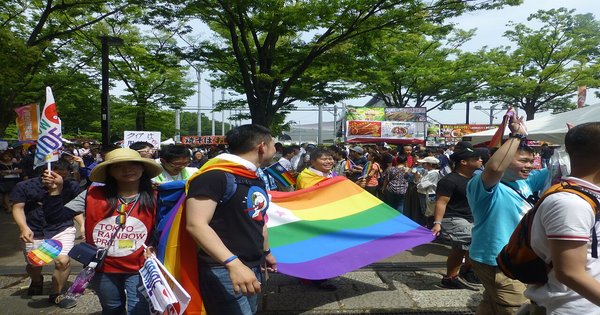
While Europe celebrates a milestone anniversary of marriage equality this month, one of the world’s largest democracies is still waiting to cross the starting line. Japan’s Supreme Court has forwarded six appeals concerning the country’s ban on same-sex marriage to its Grand Bench — the fifteen-justice panel reserved for the most constitutionally significant cases — setting up what could become the most consequential LGBTQ+ rights ruling in Asia in years.
Japan remains the only G7 country that does not recognize same-sex marriage in any form. That fact has become harder to defend in court, and the legal pressure has been building steadily.
How Japan got here
Between 2024 and 2025, a series of high courts — in Sapporo, Tokyo, Fukuoka, Nagoya, and Osaka — ruled that the government’s refusal to recognize same-sex marriage violates the constitution’s guarantees of equality and individual dignity. Not every ruling went the same way; the Tokyo High Court diverged in November 2025 by upholding the ban as constitutional. Those conflicting decisions are exactly the kind of split that pushes a question up to the top of the judicial system for a unified answer.
In March 2026, the Supreme Court’s Third Petty Bench forwarded the consolidated cases to the Grand Bench, presided over by the Chief Justice. That procedural move matters: the Grand Bench is where Japan resolves its weightiest constitutional questions, and referring the cases there signals the court intends to issue a definitive ruling rather than sidestep the issue.
What a ruling would — and wouldn’t — do
It’s worth being precise about the stakes, because Japanese constitutional review doesn’t work the way many readers might expect. Even if the Grand Bench finds the current ban unconstitutional, that does not automatically legalize same-sex marriage. Japanese courts generally cannot rewrite the law themselves; they can declare a state of affairs unconstitutional and put the onus on the Diet to legislate a fix. A finding against the ban would be a landmark — a powerful mandate — but the actual work of changing the Civil Code and family registration system would still fall to lawmakers.
That’s where the politics get complicated. The ruling Liberal Democratic Party has long resisted marriage equality, and the coalition’s recent loss of its majority in the House of Councillors — its first such setback in decades — has made the legislative path harder to read, not easier. A favorable ruling would hand advocates enormous momentum; it would not hand them a law.
Why it resonates beyond Japan
Japan would be only the third Asian jurisdiction to move toward marriage equality, after Taiwan and Nepal, with Thailand having enacted its own equal marriage law in early 2025. A ruling from a court this influential, in an economy this large, would send a signal across the region that the direction of travel is set — even where the pace is slow.
For the couples at the center of these cases, the wait has been measured in years. They are the ones who filed, testified, and put their relationships on the public record so that a court would have to answer the question directly. Whatever the Grand Bench decides, that decision will shape the lives of countless same-sex couples in Japan who currently have no legal recognition of their families, no automatic hospital visitation, no inheritance rights, and no shared legal standing as parents. We’ll be following this one closely — a reminder that even in wealthy, stable democracies, the most basic recognitions are still being argued for.
Sources: The Japan Times, Washington Blade.