Thirty years ago tomorrow, a small group of people stood in the chilly October air in Boston and did something nobody had done before in North America: they protested, in public, as intersex people.
It was October 26, 1996. The American Academy of Pediatrics was holding its annual meeting, and activists from the Intersex Society of North America, joined by allies from the trans group Transexual Menace, showed up to put doctors “on notice that intersex people were finally coming out,” as the organisers of Intersex Awareness Day recall. Morgan Holmes and the late Max Beck were among them. Their target was the routine practice of surgery on intersex babies who were far too young to consent.
In 2003, activists picked that date as the anniversary to mark every year. That’s why Intersex Awareness Day is October 26, and why many people now treat the two weeks from October 26 to November 8, Intersex Day of Solidarity, as one stretch of visibility.
So, three decades on: how much has changed in Europe?
First, a quick primer
Intersex people are born with sex characteristics (chromosomes, hormones, genitals or reproductive organs) that don’t fit typical definitions of male or female. Being intersex is about bodies, not about who you love or how you identify, though intersex people can be any sexual orientation and gender identity. In the EU’s largest survey of LGBTIQ people, 65% of the 1,920 intersex respondents also identified as trans or non-binary and gender-diverse, according to the EU Fundamental Rights Agency.
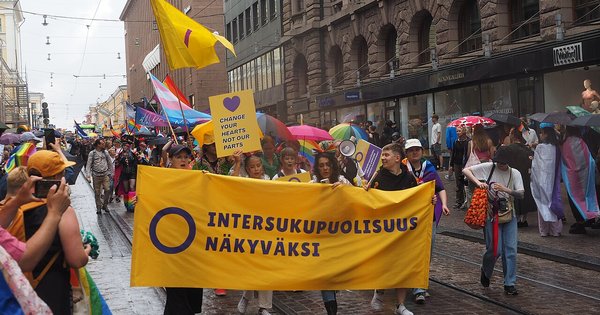
The yellow-and-purple flag you’ll see this week was designed in July 2013 by Morgan Carpenter of what is now Intersex Human Rights Australia. Its circle is meant to be “unbroken and unornamented, symbolizing wholeness and completeness,” as the flag’s history records.
The headline number: six
ILGA-Europe’s Rainbow Map 2026 says that only Germany, Greece, Iceland, Malta, Portugal and Spain prohibit unnecessary surgical or medical interventions on intersex children.
Six, out of the 49 countries the map ranks. And it gets thinner the closer you look:
- Only Greece’s ban is universal. Elsewhere, protection depends on the specific variation, diagnosis or terminology involved.
- No country has effective monitoring. ILGA-Europe says there is no country in Europe with an effective mechanism to check that the bans are actually followed.
- No country has properly reckoned with the past. None provides adequate acknowledgement of the suffering and injustice intersex people have experienced.
- Nobody gets full marks. No European country meets every intersex bodily integrity criterion on the map.
Greece’s 2022 law is the model people point to. It bars hormonal treatments and surgeries that change the sex characteristics of intersex minors under 15 without their “free and informed consent.” Procedures that genuinely can’t wait need approval from a court, after an interdisciplinary committee weighs in and the young person is heard. Doctors who break the rules face sanctions, including losing their licence, OII Europe explains.
The big new tool: a Europe-wide standard
The biggest shift since the last Intersex Awareness Day happened in Strasbourg. On October 7, 2025, the Council of Europe’s Committee of Ministers adopted Recommendation CM/Rec(2025)7 on equal rights for intersex persons. All 46 member states adopted it unanimously, ILGA-Europe reported.
It’s the first international standard written specifically for intersex people’s human rights. It asks governments to ban interventions carried out without consent, guarantee access to justice and redress, tackle hate crime and hate speech, protect intersex people in schools, work and sport, and recognise sex characteristics as a protected ground against discrimination.
Dan Christian Ghattas, executive director of OII Europe, called it “a historic and much-needed milestone.”
The catch: it isn’t legally binding. What it does do is put every government on record, and the Committee of Ministers will monitor how countries bring their laws into line. That gives intersex advocates something concrete to hold up in every national debate.
There’s a lot of catching up to do. The FRA found that only seven EU member states include sex characteristics as a protected ground in their anti-discrimination laws.
Where it could go backwards
Progress isn’t a one-way street. In Portugal, one of the six countries with a ban, three bills backed by the far right and the governing party cleared a first vote in March. One of them would undo the country’s protection against non-consensual “normalising” surgery on intersex children. We’ve been tracking the bills, which have since sat in committee.
Across the Balkans, where we focus much of our coverage, none of the countries appears on ILGA-Europe’s list of six.
Why it matters
The 1996 protest was about one simple idea: decisions about a person’s body should be made by that person, when they’re ready. Thirty years later, Europe has finally written that idea into a shared standard. Most governments just haven’t made it law yet.
If you’re intersex: this week is yours, and so is the decision about what you share. If you’re not: listen to intersex-led groups, and keep the I in LGBTI on purpose, not as an afterthought.
Sources: Intersex Awareness Day organisers; ILGA-Europe Rainbow Map 2026: intersex bodily integrity; ILGA-Europe on CM/Rec(2025)7 (Oct 7, 2025); OII Europe on Greece’s law (Jul 21, 2022); EU Fundamental Rights Agency, Being intersex in the EU (Sep 17, 2025); Wikipedia: Intersex flag. Photo: JIP, Helsinki Pride 2023, CC BY-SA 4.0, via Wikimedia Commons.