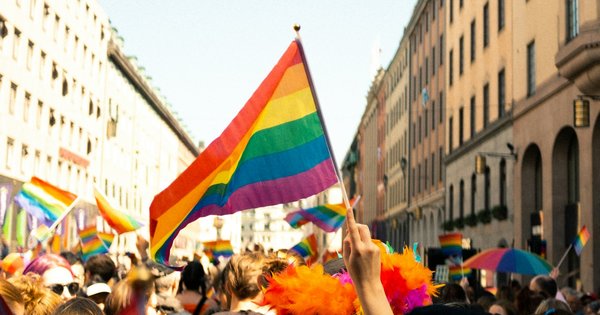
For most of the past year, a schoolteacher in the southern Hungarian city of Pécs had a criminal case hanging over him for the ordinary act of helping people gather in public. This June, that case ended — and the way it ended tells you something hopeful about where the ground is shifting in Europe, even as the pressure on LGBTQ+ people across the continent stays real.
What happened in Pécs
Géza Buzás-Hábel is a teacher of Romani language and culture, a trainer of future educators, and a gay Roma man from Pécs. In the autumn of 2025 he did what organizers do: on 4 September 2025 he formally notified the authorities that a Pride march would take place in the city. The following day, 5 September, the police banned it, invoking Hungary’s so-called “child protection” law — the same legal machinery Viktor Orbán’s government used to ban Budapest Pride. On 14 September, Hungary’s Supreme Court upheld the ban.
The march went ahead anyway. On 4 October 2025, people walked through Pécs peacefully, without incident. By several accounts it was the largest Pride the city had ever seen. Then, on 9 February 2026, the Pécs District Prosecutor’s Office charged Buzás-Hábel under Article 217/C of the Hungarian Criminal Code for organizing a prohibited assembly. The maximum penalty was one year in prison.
The case drew unusual international attention. Amnesty International launched an urgent action. Human Rights Watch called the prosecution “a warning to all protesters,” making the point that a law dressed up as being about LGBTQ+ content was really about who gets to assemble at all. The International Federation for Human Rights (FIDH), the World Organisation Against Torture, and United Nations special rapporteurs all raised his case. For months, a man whose job was teaching children faced the possibility of a criminal record for standing with his community.
Why the charges were dropped
In June 2026, Hungarian prosecutors dropped all charges. The reason they cited is the part worth sitting with: the landmark ruling in Commission v Hungary from the Court of Justice of the European Union.
That ruling, handed down on 21 April 2026, found that Hungary’s 2021 anti-LGBTQ law breaches EU law on multiple levels — not only equality and non-discrimination provisions, but core values in Article 2 of the EU treaties. It was the first time the EU’s top court had gone that far in defense of LGBTQ+ rights, and it landed just after Orbán’s Fidesz party lost the parliamentary election to the opposition Tisza Party. The legal foundation the Pécs ban rested on had, in effect, been pulled out from under it.
So the dropped charges are not a case of prosecutorial mercy. They are the downstream consequence of a European court telling a member state that its anti-Pride law cannot stand. One ruling in Luxembourg reached a courtroom in Pécs and closed a file that never should have been opened.
Why this matters beyond one man
It would be easy to file this under “Hungary” and move on, but the reach is wider. Hungary spent several years building a template that governments elsewhere studied closely: pass a law framed around protecting children, use it to ban LGBTQ+ gatherings, and let the criminal code do the rest. The prosecution of a single teacher was that template working exactly as designed — the deterrent isn’t really the fine or the prison term, it’s the message to the next organizer in the next small city who now has to weigh whether a peaceful march is worth a police file.
That is why the Commission v Hungary ruling matters far past Budapest, and why we keep coming back to it from the Balkans, where anti-gender movements borrow the same playbook and EU accession gives Brussels real leverage. When a court establishes that banning Pride violates EU law, it doesn’t only protect the people marching in Hungary. It raises the cost of copying the template anywhere the EU’s authority reaches.
There is also the human scale of it, which is the part that stays with us. Buzás-Hábel is Roma and gay in a country where both of those facts carry weight, and he is a teacher — someone whose whole vocation is showing young people how to move through the world. The state tried to make an example of him. In the end, the example points the other way: he organized a peaceful march, thousands came, and the charges collapsed under the weight of European law.
None of this means Hungary’s LGBTQ+ community can exhale. The 2021 law is still on the books pending repeal, the political transition is young and unfinished, and a court ruling only becomes protection when it is enforced on the ground. But for once the sequence ran in the right direction — a ban, a peaceful act of defiance, an international outcry, a court, and then a case that simply ended. That is worth marking.
Sources: Amnesty International victory statement, Human Rights Watch, FIDH, Al Jazeera on the CJEU ruling.