Coos Huijsen, the Dutch politician widely remembered as the first openly gay member of a national parliament anywhere in the world, has died. He was 87.
He died on Monday, October 19, at home in Amsterdam after a brief illness, with his husband, Lank Bos, at his side, NL Times reported, citing a statement from his family. The Dutch parliamentary archive Parlement.com gives the same date.
By a quiet twist of the calendar, it was the same Monday that the Netherlands’ prime minister, Rob Jetten, announced that he and his fiancé are expecting their first child. Fifty years separate the two men’s moments in public life. Huijsen helped make the second one ordinary.
The swearing-in that changed everything
Jacobus “Coos” Huijsen was born in The Hague on March 20, 1939, and trained as a teacher. He first sat in the Tweede Kamer, the Dutch House of Representatives, for six months in 1972, for the Christian Historical Union (CHU). He left the party the following year, feeling it had moved too far to the right, according to Parlement.com.
On March 30, 1976, he returned to parliament as an independent, a one-man faction, filling a vacated seat.
That swearing-in is where the story turns. Lank Bos, his partner, came along. When Bos explained that he was there as Huijsen’s partner, he was challenged. Huijsen objected to how Bos was treated, and the incident became the turning point in his decision to speak openly about his sexuality, NL Times reports.
He came out that year, while a sitting member of parliament. Wikipedia’s account calls him the first known openly gay member of a national legislature in the world. Parlement.com is more careful: it says that, by his own account, he was the first parliamentarian in the world to openly acknowledge his homosexuality. Either way, nobody has produced an earlier example.
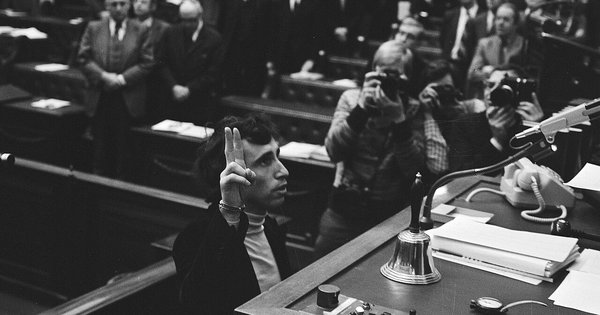
The photo at the top of this page is that day, March 30, 1976: a 37-year-old Huijsen raising two fingers to take the oath, press cameras pressed in around him.
A short time in parliament, a long life of work
His second term lasted just over a year, until June 8, 1977. During it, he introduced an amendment, which passed, removing a limit in the Dutch Constitution on freedom of association on the grounds of public morals, according to Parlement.com.
Then he went back to the classroom. He taught history at the Gerrit van der Veen school in Amsterdam and ran it as director from 1986 to 1998. He joined the Labour Party (PvdA) in 1977.
He never stopped writing or organising:
- A historian of the monarchy. He wrote widely about the House of Orange and earned a PhD from the University of Amsterdam in 2012, at 73.
- A funder of emancipation. He chaired Het Blauwe Fonds, a foundation that supports LGBTQ+ emancipation projects, from 2009 until 2018, according to Parlement.com (NL Times describes him as its co-founder).
- A memoirist. His autobiography, Homo Politicus, came out in 2016. An updated edition, Roze Draad (“Pink Thread”), subtitled Struggle, Success and Stagnation in Fifty Years of Gay Emancipation, appeared earlier this year.
In 2017 he was made a Knight in the Order of Orange-Nassau.
Why he still matters
Think about what coming out in 1976 meant. There was no playbook, no out colleagues across the aisle, no other country’s parliament to point to. Huijsen didn’t plan a grand announcement. He saw the person he loved being treated as if he didn’t belong in the room, and he refused to let that stand.
That’s the part worth holding on to. Representation often starts with one person deciding that a small indignity is one too many.
Half a century later, the Netherlands, which in 2001 became the first country to open civil marriage to same-sex couples, has an openly gay prime minister. Out politicians now serve in parliaments across Europe. Every one of them walks into a room a little easier because someone, once, walked in first. For a lot of them, that someone was Coos Huijsen.
He is survived by his husband, Lank Bos.
Sources: NL Times (Oct 21, 2026, with ANP); Parlement.com obituary (Oct 20, 2026, in Dutch) and biography (in Dutch); Wikipedia: Coos Huijsen. Photo: Bert Verhoeff / Anefo, Nationaal Archief, CC0, via Wikimedia Commons.